Who can provide hearing services
Program services must be provided by an audiologist or audiometrist who is either a:
- qualified practitioner (QP)
- provisional practitioner under the supervision of a QP.
They must be a member of a recognised practitioner professional body (PPB) in an approved membership category.
They must also comply with the PPB scope of practice and code of conduct.
Recognised practitioner professional bodies (PPB)
We recognise these organisations as practitioner professional bodies (PPB):

Audiology Australia

Australian College of Audiology incorporating Hearing Aid Audiology Society of Australia (ACAud)
Approved membership categories
These are the approved membership categories for each PPB.
AudA
- Member Accredited
- Member Fellow Accredited
- Member Life Accredited
- Member Accredited Limited Scope Audiologist
ACAud incorporating HAASA
- Full member
- Fellow member
Qualified practitioners (QP)
All qualified practitioners must have both:
- a current approved membership with a PPB
- an active QP number.
When checking a practitioner’s qualifications, providers must confirm the practitioner holds an approved PPB membership category before requesting or linking a QP number. You can view sample certificates for approved membership categories.
QP audiologists and QP audiometrists must also meet the requirements below.
QP audiologists
QP audiologists must have an Australian university master’s degree in clinical audiology (or equivalent) and either:
- current financial Member Accredited, Member Fellow Accredited, or Member Life Accredited membership with Audiology Australia
- current financial full or fellow membership with the Australian College of Audiology incorporating HAASA, with a certificate of competency for Hearing Rehabilitation Specialist and Diagnostic Rehabilitation Specialist.
Some QP audiologists operate within a restricted scope of practice and are considered restricted scope audiologists. They will have an overseas university qualification and either:
- current financial Member Accredited Limited Scope Audiologist membership with Audiology Australia
- current financial full or fellow membership with the Australian College of Audiology incorporating HAASA, with a certificate of competency for Hearing Rehabilitation Specialist only.
QP audiometrists
QP audiometrists must have either:
- an Australian tertiary diploma in audiometry
- a bachelor’s degree in audiometry (or equivalent).
They must also have current financial full or fellow membership with the Australian College of Audiology incorporating HAASA, with a certificate of competency for Hearing Rehabilitation Specialist.
Provisional practitioners
Provisional practitioners must have a supervision arrangement with a qualified practitioner and their PPB. Practitioners should contact their PPB for details.
Provisional practitioners cannot hold a QP number under the program.
Provisional practitioner audiologists and audiometrists must also meet the requirements below.
Provisional practitioner audiologists
A provisional practitioner audiologist must have an Australian university master’s degree in clinical audiology (or equivalent) and either:
- financial Member Non-Accredited membership or Member Non-Accredited Limited Scope Audiologist membership with Audiology Australia
- full membership (intern) with the Australian College of Audiology incorporating HAASA.
Provisional practitioner audiometrists
A provisional practitioner audiometrist must have either:
- an Australian tertiary diploma in audiometry
- a bachelor’s degree in audiometry (or equivalent).
They must also have associate membership with the Australian College of Audiology incorporating HAASA.
QP numbers
Providers must only request QP numbers for practitioners:
- in approved membership categories for qualified practitioners
- that do not already have a QP number.
Providers must not request QP numbers for students or provisional practitioners.
Legislation allows us to share QP information with PPBs and program providers to check program compliance.
Requesting a QP number
If you do not already have one, your employer can request a QP number for you through the Hearing Services Program online portal. You must:
- meet all the QP requirements
- ensure the provider uses the same name as your PPB membership.
You only need one QP number for all the employers you work for. Your QP number stays with you even if you change employer.
If you are not sure you have a QP number, contact us before your employer requests a new QP number.
Linking to employers
Any employer you start working for must link your QP number to their business through the Hearing Services Program online portal. You can be linked to multiple employers.
When you finish working with an employer, they must unlink your QP number from their business through the portal.
Updating QP number records
Provide your employer with evidence of your new membership if:
- your qualification changes from audiometrist to audiologist
- you change PPB or membership category.
If you have changed your name, provide your employer with proof of identity. Your QP record in the portal should match your PPB record.
Your employer must email us the relevant documents so we can update your QP record in the portal.
Reactivating your QP number
Your QP number only remains active while you are in an approved membership category of a PPB.
To reactivate your QP number, you or your employer can email us evidence that you hold an approved membership category. We will then reactivate your QP number.
Employers can read our portal user guide on managing practitioners.
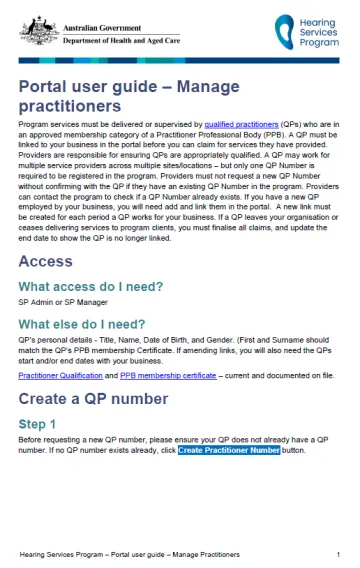
Hearing Services Program portal user guide – Manage practitioners
Using your QP number
Your employer uses your QP number to claim for program services:
- you provide
- the provisional practitioner you supervise provides.
Providers should ensure file notes record the full name of the practitioner who delivered or supervised each service.
Contact