
Filter results
You can narrow down the results using the filters
Audience
Topics
Our work
Diseases
1167 results
-
 35:29
35:29Personal care information sessions for Support at Home providers #8
Provides guidance to Support at Home providers on expected impacts of the upcoming changes to personal care contribution arrangements, effective 1 October 2026 and how to prepare and implement the changes. -
 01:38
01:38Your screening choices – National Cervical Screening Program – Video
A video for First Nations women about the choices available when doing a Cervical Screening Test. -
 01:48
01:48Understanding cervical screening – National Cervical Screening Program – Video
A video for First Nations women about cervical screening. -
 8:38
8:38Personal care information sessions for Support at Home providers #7
This video provides information and guidance for aged care providers on the upcoming personal care contribution changes for Support at Home. Representatives from the department and Services Australia attend the sessions to assist providers. -
 38:31
38:31Personal care information sessions for Support at Home providers #6
Fortnightly provider information sessions for aged care providers to ask questions and seek clarification about the personal care contribution changes. Representatives from the department and Services Australia attend these sessions. -
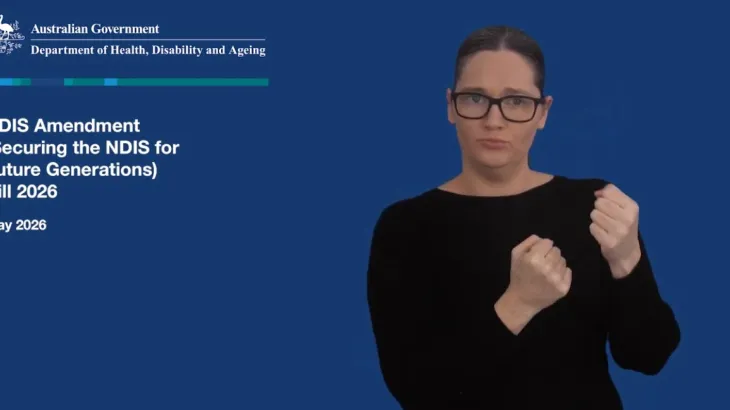 14:57
14:57NDIS Amendment (Securing the NDIS for Future Generations) Bill 2026 – Auslan Video
The National Disability Insurance Scheme Amendment (Securing the NDIS for Future Generations) Bill 2026 will make changes to the National Disability Insurance Scheme Act 2013. This video is a summary of key changes in the Bill. -
 15:22
15:22Changes to the NDIS Amendment (Securing the NDIS for Future Generations) Bill 2026 – Auslan
The National Disability Insurance Scheme Amendment (Securing the NDIS for Future Generations) Bill 2026 will make changes to the National Disability Insurance Scheme Act 2013. This is an Auslan version of a fact sheet summary of recent amendments agreed to in response to feedback, -
 12:29
12:29Consultation on NDIS Supports Rules – Auslan
An Auslan translation of the Consultation on NDIS Supports Rules (2025) - summary report, which provides a summary of feedback received during consultation. -
 0:30
0:30One more way you keep them safe
Childhood immunisation is a safe, free and effective way to protect your kids from serious diseases.
-
 1:50
1:50What is the childhood immunisation schedule?
Hear about when and why children are recommended to receive the vaccines listed on the immunisation schedule with immunisation nurse, Deidre Brogan. -
 01:00
01:00Routine Childhood Immunisation – Why timing is important
This video explains why timely childhood vaccination is important to protect your child from serious illness. It explains the safety and effectiveness of each vaccine, how many doses are required for full protection, and the age at which vaccines provide the best protection. -
 00:58
00:58Routine Childhood Immunisation – How vaccines work
When a child is vaccinated, their immune system produces antibodies, helping protect them from infection. This video explains the importance of parents following the National Immunisation Schedule, to ensure their child have the best protection against diseases. -
 01:11
01:11Routine Childhood Immunisation – Simple and safe
Routine childhood immunisation is a simple, safe and effective way to protect children against serious preventable diseases. This video explains the importance of having high immunisation rates, vaccine safety and the immune system’s natural response to the vaccine. -
 1:47
1:47First Nations – One more way you keep them safe
This animation for Aboriginal and Torres Strait Islander families explains all you need to know about childhood vaccinations. -
 2:03
2:03How vaccines work for pregnancy and newborns
This animation explains how vaccines help your immune system to make antibodies to help fight serious diseases. It helps parents understand how vaccines help while pregnant to protect the baby when they are born. -
 1:54
1:54Tips for your child's vaccination appointment
Learn about what you can expect before, during and after your child’s vaccination appointment with immunisation nurse, Deidre Brogan. -
 03:00
03:00Dr Ehab Mostokly explains why childhood immunisations are important – Arabic
Childhood vaccinations help protect babies and young children from serious diseases. In this video, a trusted healthcare professional answers common questions about childhood immunisation. -
 03:29
03:29Dr Lucy Deng explains why childhood immunisations are important – Cantonese
Childhood vaccinations help protect babies and young children from serious diseases. In this video, a trusted healthcare professional answers common questions about childhood immunisation. -
 02:41
02:41Dr Jung Yoon Huh explains why childhood immunisations are important – Korean
Childhood vaccinations help protect babies and young children from serious diseases. In this video, a trusted healthcare professional answers common questions about childhood immunisation. -
 2:49
2:49Dr Lily Vu explains why childhood immunisations are important – Vietnamese
Childhood vaccinations help protect babies and young children from serious diseases. In this video, a trusted healthcare professional answers common questions about childhood immunisation. -
 3:24
3:24What is pertussis (whooping cough)? Why childhood immunisations are important
Pertussis, also called whooping cough, is a bacterial infection that can have serious complications in children. -
 3:02
3:02What is influenza? Why childhood immunisations are important
Influenza is a common and contagious viral infection and can be serious in children.
-
 3:45
3:45What is meningococcal? Why childhood immunisations are important
Meningococcal is a contagious bacterial infection that can be fatal in children and requires emergency medical attention. -
 2:35
2:35What is rotavirus? Why childhood immunisations are important
Rotavirus is a viral infection that can be dangerous in babies and children as it can cause serious gastro symptoms. -
 3:04
3:04What is varicella (chicken pox)? Why childhood immunisations are important
Varicella, also known as chickenpox, is a highly contagious virus that causes discomfort and can be dangerous in babies and pregnant people.