The Australian National Aged Care Classification (AN-ACC) price is $303.19 from 1 October 2026.
The Australian Government sets the AN-ACC price annually based on advice from the Independent Health and Aged Care Pricing Authority (IHACPA).
Find out more about IHACPA's 2026-27 Residential Aged Care Pricing Advice.
For more information about residential aged care pricing, contact enquiries.ihacpa@ihacpa.gov.au.
Value of AN-ACC price attributable to award wage increases
Of the 1 October 2026 AN-ACC price:
- $1.91 is attributable to the 1 August 2026 FWC award wage increases for aged care nurses
- $0.05 is attributable to the 1 October 2026 and 30 June 2027 FWC award wage increases for allied health professionals.
Providers are required to attest in the Quarterly Financial Report that they have passed on additional funding to increase minimum award rates for aged care workers.
How we fund residential aged care
The Australian Government funds approved residential care homes through:
- the AN-ACC funding model to subsidise clinical and non-clinical care
- supplements to help with the cost of special care needs, fees and accommodation (if eligible), everyday living services and meeting certain obligations
- other funding, such as capital grants.
An older person must be assessed and approved for government-funded residential permanent care or respite care. This entitlement is known as their residential care place.
Registered providers submit a monthly claim to Services Australia to receive subsidies and supplements on behalf of each resident to meet their assessed care needs.
Based on their financial circumstances, residents also contribute to their aged care costs. Learn more about charging for residential aged care.
About the AN-ACC funding model
The AN-ACC funding model funds the care component of residential aged care. The model links funding to the:
- characteristics of residential care homes (including location using the Modified Monash Model (MMM) and specialised status)
- assessed care needs of residents.
AN-ACC provides equitable funding for registered providers to better match residents’ needs and the costs of:
- delivering clinical and non-clinical services in the Residential Care Service List
- meeting care minutes obligations
- outbreak management (for clinical and non-clinical services costs)
- Fair Work Commission award wage increases for care workers.

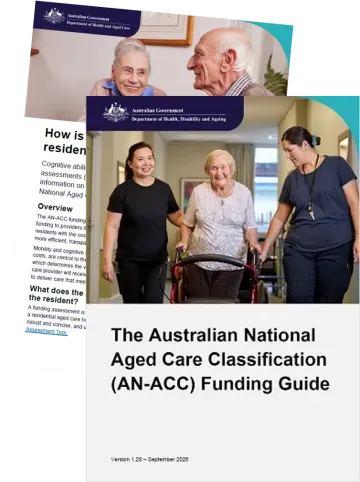
The Australian National Aged Care Classification (AN-ACC) funding guide
AN-ACC price and weightings
AN-ACC works by applying National Weighted Activity Units (NWAU) to the National Efficient Price for AN-ACC (the AN-ACC price).
The NWAU is a measure used to determine fixed and variable funding components of the daily basic subsidy. The NWAUs reflect variations in the costs of providing care, based on the characteristics of a home and its individual residents. The AN-ACC price is the price of a unit of care, or 1.00 NWAU.
The government updates the AN-ACC price on 1 October each year, in line with pricing advice from the Independent Health and Aged Care Pricing Authority.
See the Schedule of Subsidies and Supplements for the current AN-ACC price and NWAUs.
Supplements
Supplements provide additional funding to help with the cost of:
- meeting specific care needs (e.g., enteral feeding)
- delivering everyday living services (e.g., catering, cleaning and laundry)
- fees and accommodation, depending on residents’ financial circumstances
- complying with certain requirements (e.g., 24/7 registered nurse supplement).
For some supplements, we automatically check eligibility for you. For others, you need to apply on a resident’s behalf.
Subsidy reductions
Reductions apply if the resident gets a compensation payment or pays means tested fees. This adjusts the subsidy amount you receive to account for these payments.
Independent pricing analysis
The Independent Health and Aged Care Pricing Authority (IHACPA) provides annual recommendations to the government on the:
- AN-ACC price
- BCT and AN-ACC classification NWAU values
- gap between everyday living revenue and funding (to inform the hotelling supplement).
IHACPA’s advice is based on their determination of actual costs of delivering care by analysing financial reporting, independent costing studies and other data.
We also adjust care minute allocations annually in line with IHACPA’s recommendations.
Learn more about IHACPA's pricing advice and consultations.
Current rates
Following IHACPA’s pricing advice, AN-ACC price and NWAU weightings change on 1 October each year and the hotelling supplement is indexed on 20 September each year.
The 1 October implementation date allows IHACPA's annual pricing advice to reflect the Fair Work Commission's Annual Wage Review (AWR). This includes the most recent actual wage increase and an estimate of the next AWR outcome from 1 July, which are incorporated into the pricing advice used to inform annual AN-ACC price updates. This approach ensures the AWR is considered each year through the AN-ACC pricing process.
Care-related supplements are indexed on 1 July each year.
Accommodation supplements are indexed on 20 March and 20 September each year, in line with pension increases.
View the current rates in the Schedule of Subsidies and Supplements.
Other funding available
The Australian Government also funds other areas of residential aged care, such as the:
- Aged Care Capital Assistance Program
- Specialist Dementia Care Program
- aged care on-site pharmacist
- financial viability and capability support
- Translating and Interpreting Service for aged care.
Reporting
Registered providers must report on residential aged care income and expenses through the annual Aged Care Financial Report and the Quarterly Financial Report.
Learn more about reporting for residential aged care.
Resources
AN-ACC resources
Contacts

Aged care subsidies and supplements contact