
Provider responsibilities
You must understand and carry out your responsibilities as a registered provider set out in the Aged Care Act 2024.
As a residential aged care provider (category 6), you must:
- meet the Aged Care Quality Standards
- use and report funds properly
- have an incident management system in place.
- have at least one registered nurse onsite and on duty at all times
- deliver a certain number of direct care minutes to residents each quarter
- publish accommodation prices
- seek approval to charge above the maximum accommodation payment amount
- report the number of offline beds and vary registration to change total beds.
Use the Aged Care Provider Requirements Search tool to find your requirements.
Services you can provide
You must provide care and services set out in the Residential Care Service List, including:
- accommodation
- everyday living
- non-clinical care
- clinical care.
If the resident agrees, you can also charge for some higher everyday living, additional and extra services.
Learn more about delivering services under residential aged care.
Responsibilities to residents
You are responsible for delivering safe, high-quality aged care services for all residents in line with aged care legislation, including the Statement of Rights.
You must provide a minimum amount of care time and have a registered nurse (RN) onsite and on duty at all times in your residential care home. These obligations are called the care minutes responsibility and the 24/7 RN responsibility.
For each person in your care, you must:
- create an Aged Care Entry Record form
- discuss fees and charges with the resident
- complete a service agreement, an accommodation agreement and higher everyday living agreement, if needed
- have ongoing care discussions.
These fact sheets can help explain fee arrangements to your residents.
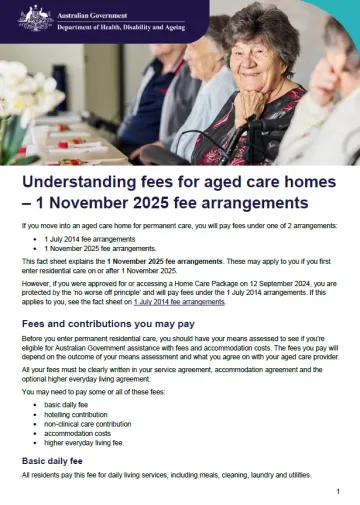
Understanding fees for aged care homes fact sheets
Responsibilities to staff
Your workforce must be skilled and qualified to provide safe, respectful and quality care and services. This includes complying with worker screening requirements and delivering services in line with the Aged Care Code of Conduct.
You are responsible for supporting staff so they can provide quality care. This includes providing:
- training and development opportunities
- access to vaccinations.
Learn more about aged care workforce.
Reporting requirements
You must meet certain reporting requirements, including:
- submitting the Aged Care Financial Report, including an audited Care Minutes Performance Statement and Annual Prudential Compliance Statement
- submitting the Quarterly Financial Report, including care time reporting
- collecting and providing quality indicator data
- reporting monthly 24/7 RN coverage for each residential facility
- reporting individual refundable deposit balances to Services Australia in monthly claim forms
- reporting beds as offline or to make offline beds available for use to the Local Network
- notifying the Government about some changes (e.g. advising Services Australia when a person enters your service)
- notifying the Aged Care Quality and Safety Commission (ACQSC) of reportable incidents under the Serious Incident Response Scheme.
Find out more about reporting for residential aged care.
Flu and COVID-19 vaccination program
Regular vaccinations are the best defence against severe illness, hospitalisation and death. Aged care residents are particularly vulnerable to severe illness from infectious disease.
You must have processes in place to manage infectious respiratory diseases in aged care. This is a requirement under the Aged Care Quality Standards (Outcomes 4.2 and 5.2).
What you need to do
You must take precautions to prevent and control the flu and COVID-19, and minimise infection-related risks. These precautions include:
- identifying and complying with all relevant Commonwealth, state or territory legislation and regulatory requirements
- having an effective infection prevention and control program in line with national guidelines
- offering free annual flu vaccinations and COVID-19 vaccinations to your residents and staff, and keep records of their vaccinations
- providing vaccinations in accordance with the Australian Immunisation Handbook.
Monitoring compliance
The ACQSC assesses compliance with the flu vaccination program and monitors COVID-19 vaccinations rates.
The ACQSC may seek evidence of your infection control practices, including:
- having the systems in place to support the prevention and management of COVID-19 and flu outbreaks
- assessing how you have informed and promoted the benefits of vaccination to your staff and volunteers
- reviewing the steps you have taken to promote the value of vaccination to staff, volunteers, family and visitors.
