About care minutes
Care minutes are the amount of direct care that older people living in residential care receive from a:
- registered nurse (RN)
- enrolled nurse (EN)
- personal care worker (PCW) or assistant in nursing (AIN) – also known as nursing assistants.
The care minutes requirement is based on a sector-wide average of 215 minutes of care per resident per day, including 44 minutes of direct RN care.
See the Care minutes in residential aged care dashboard for an overview of the amount of care minutes reported across the sector.
For detailed guidance, refer to Care minutes – guide for registered providers of residential care homes, including:
- Section 3 on the workers that can deliver care minutes, including the definition of PCWs/AINs.
- Section 4 for the types of activities that can be counted as direct care minutes.
Why it is important
Mandatory direct care minutes were introduced in response to the Royal Commission into Aged Care Quality and Safety.
Mandatory care minutes ensure that older people in residential care homes receive the dedicated care time they need.
Funding for care minutes
The Australian National Aged Care Classification (AN-ACC) funding model funds the delivery of the care component of residential aged care, including direct care minutes.
For non-specialised homes in metropolitan areas (MM1), some care funding will be linked to the delivery of care minutes from 1 April 2026. This funding will be paid through the care minutes supplement.
For more information, refer to the changes coming to care minutes funding fact sheet and frequently asked questions.
Amounts of direct care minutes for individual homes
You must deliver a certain number of direct care minutes to residents in the home (on average) each quarter.
This requirement applies to all permanent care and respite care residents in a home.
There are exceptions for residents on long-term leave. See Section 4 of the Care minutes guide.
You must also give older people proper care, based on their specific care needs in their individual care plan.
Calculating care minutes targets for individual homes
To work out the required amount of direct care minutes for your home, use the method set out in section 176-20 of the Aged Care Rules 2025.
You can use calculator to calculate your care minutes targets.
We use the same method to work out the care minutes targets for each home.
See the latest targets at Care minutes targets in residential aged care by home. Historical targets are available with care minutes performance for individual homes.
Contact us if you have a query about your published care minutes target.
Reporting
Your care minutes are determined from the care hours you report in the Quarterly Financial Report (QFR) from RNs, ENs, PCWs and AINs. Read more about care minutes reporting in the QFR.
24/7 RN and Care Minutes Reporting Assurance Activities check the accuracy of this data.
Starting in the Aged Care Financial Report 2025–26, you will be required to prepare and submit a new Care Minutes Performance Statement that must be externally audited.
Compliance
We provide QFR data on your direct care minutes and 24/7 RN requirement reporting to the Aged Care Quality and Safety Commission (ACQSC) to support its regulatory work.
If you do not meet your direct care minutes requirement, the ACQSC may take action to address your non-compliance.
We also publish care minutes performance for individual homes data sets quarterly to allow the public to see whether each home and provider is complying with the care minutes requirement:
Read:
- more about the ACQSC’s approach to regulating workforce-related responsibilities
- a letter from the former Minister for Aged Care on care minutes compliance.
Learn more
For providers

Care minutes funding changes – April 2026

Care minutes supplement – frequently asked questions

Care minutes supplement estimator

Care minutes in residential aged care – information for workers

Care minutes and 24/7 registered nurse requirements – guides for registered providers of residential care homes
For older people

Care minutes in aged care homes
Dashboard
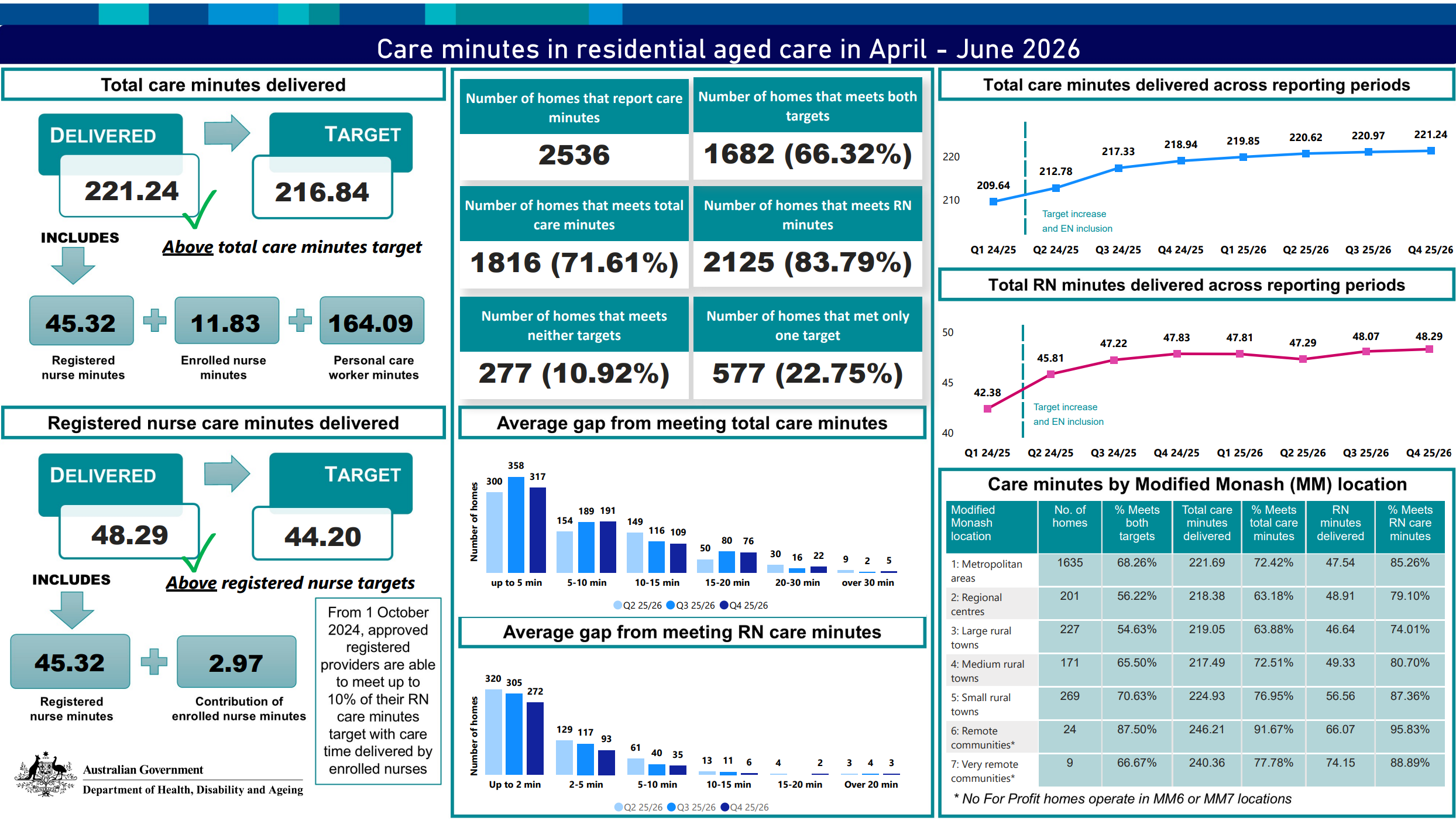 View text description and larger image of 'Care minutes in residential aged care dashboard' graphic
Contact