

Perimenopause – the time around menopause
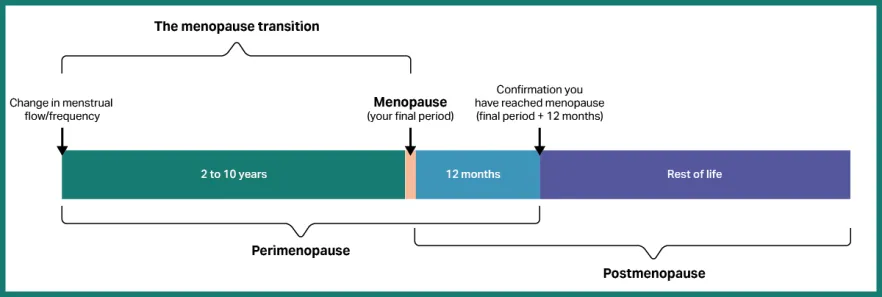
Perimenopause is the time leading up to your final period (menopause) and ends 12 months after menopause.
During perimenopause, the levels of oestrogen and progesterone, hormones produced by your ovaries, begin to change.
Symptoms can be mild for some, and much more severe for others. Many women say they feel confused and not like themselves during perimenopause.
Perimenopause can begin years before your final period. It often starts in your 40s but can start earlier or later. It usually lasts for 4 to 6 years but can last anywhere from 2 to 10 years.

Menopause – a point in time
Menopause is your final period. You know you’ve reached menopause when you have not had a period for 12 months, with no other medical reason for it.
At menopause, your ovaries have stopped releasing eggs and producing the hormones oestrogen and progesterone. Natural pregnancy is no longer possible.
Menopause usually occurs between the ages of 45 and 55, however some people experience menopause earlier or later.

Postmenopause – after menopause
Postmenopause begins after menopause (your final period) and lasts for the rest of your life. In postmenopause, your ovaries no longer produce eggs or the hormones oestrogen and progesterone.
In postmenopause, some menopause-related symptoms will ease. However, for some symptoms can continue for years.
Looking after your health, including bone and heart health, is important leading up to and during postmenopause.

The menopause transition
The ‘menopause transition’ includes perimenopause and menopause. Everyone's experience with menopause will be different.
During the menopause transition the levels of oestrogen and progesterone, hormones produced by the ovaries, change. This causes menopause-related symptoms. Women might also describe these symptoms as ‘perimenopause symptoms’, ‘menopause symptoms’ or ‘menopausal symptoms’.
Oestrogen is one of the main female sex hormones. Oestrogen plays a very important role in the body, including in the menstrual cycle, fertility, pregnancy, bone strength, brain function, bladder health and protecting against heart disease.
Progesterone is another female sex hormone. Blood levels of progesterone increase in the second half of the menstrual cycle which prepares the uterus (womb) for a possible pregnancy. Progesterone also plays a major role in pregnancy.

The graph illustrates the stages and names of each part of the menopause transition.
Symptoms
Learn about the menopause-related symptoms you might experience.
Managing your symptoms at home
Learn about things you can do to help manage your symptoms.
Treatments
Read about treatments for menopause-related symptoms that are available in Australia.
Getting help
There are many health professionals who can support you.
Personal stories

Abby
“Along with my sister and my friends, I blamed symptoms of perimenopause on a range of different things.”

Meg
“It is not an old lady thing! You can get help and support – don’t wait around”

Bec
“I’m not going into this lying down. I want the story of menopause to be one of empowerment – I’m just not going to be beaten by it.”
Campaign video
Wondering if you could be in perimenopause? It usually starts in your 40s, but it can be earlier.

Perimenopause. Some say it’s their wonder woman era. Like, I wonder, what did I come in here for?
Or you’re trying to sleep, but you’re rethinking every awkward moment you’ve ever had.
Then your body’s on fire. No warning. Just spontaneous combustion.
Wondering if this is perimenopause? It usually starts in your 40s, but it can be earlier.
For information and support, visit health.gov.au/perimenopause
Disclaimer
Not everyone who experiences perimenopause or menopause identifies as a woman
Menopause can affect many women, some trans men, non-binary and gender diverse people. People with innate variations of sex characteristics (intersex) are a diverse population who may experience menopause. Throughout this website, we use both ‘woman/women’ and ‘people’ to reflect the diversity of those with a lived experience of menopause and to make our content as accurate and inclusive as possible.
The information on this website is not medical advice
All information provided on this website is for general educational purposes only. It is not intended to be, and should not be, relied upon as a substitute for professional medical advice, diagnosis or treatment.
Symptoms of perimenopause and menopause can overlap with those of other medical conditions. Treatments for menopause-related symptoms are not suitable for all people. For these reasons, it is important to seek advice from a qualified health professional to ensure an accurate diagnosis and appropriate care.
Do not disregard or delay seeking professional medical advice because of information provided on this website.