
Resources for First Nations women
Menopause and perimenopause resources have been developed in partnership with First Nations women and community health professionals.
This work was guided by the lived experiences and voices of First Nations women to help ensure the information is culturally informed, relevant and practical for Aboriginal and Torres Strait Islander communities.
The resources were informed by a series of yarning circles, where First Nations women from regional and remote communities shared their knowledge and lived experiences of perimenopause and menopause, helping to shape the content and design of the resources.
Every First Nations community has its own ways of practicing Women’s Business. We encourage you to use and adapt these resources in ways that feel right for you and your community.
Posters
-

Wondering if you could be in perimenopause or menopause? – First Nations Poster
This poster provides information on different symptoms that you can experience if you are going through menopause or perimenopause.
For Aboriginal communities
-

Am I going through the change of life? – Poster for Aboriginal communities
Information about “the change of life” – what perimenopause and menopause means for women and their bodies. -

Symptoms checklist – Poster for Aboriginal communities
Information about “the change of life” – what perimenopause and menopause means for women and their bodies. -

Why am I so hot all the time? – Poster for Aboriginal communities
Information about “the change of life” – what perimenopause and menopause means for women and their bodies.
For Torres Strait Islander communities
-

Am I going through the change of life? – Poster for Torres Strait Islander communities
Information about “the change of life” – what perimenopause and menopause means for women and their bodies. -

Symptoms checklist – Poster for Torres Strait Islander communities
Information about “the change of life” – what perimenopause and menopause means for women and their bodies. -

Why am I so hot all the time? – Poster for Torres Strait Islander communities
Information about how women may feel during “the change of life” and how to find support if needed.
Fact sheets
-
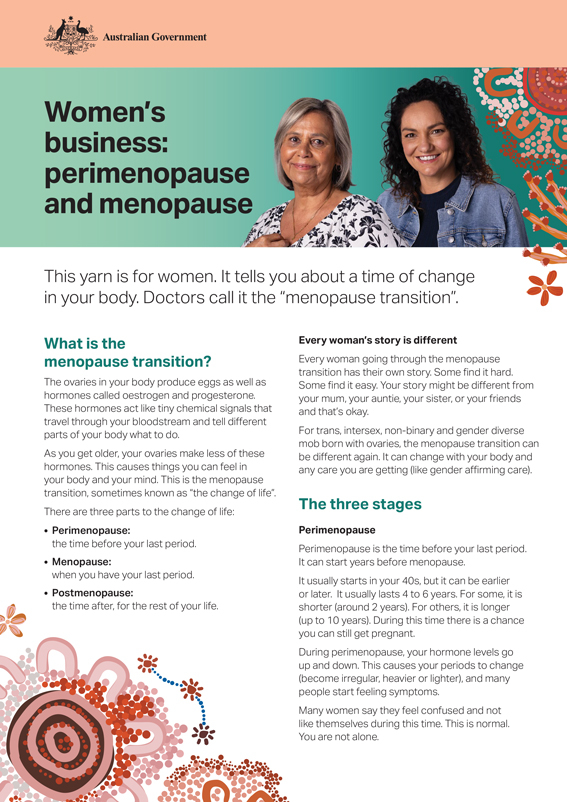
Women's business: perimenopause and menopause fact sheet
This fact sheet tells you about a time of change in your body. Doctors call it the "menopause transition".
For Aboriginal communities
-

Got any symptoms? – Checklist for Aboriginal communities
Information about “the change of life” – what perimenopause and menopause means for women and their bodies.
For Torres Strait Islander communities
-

Got any symptoms? – Checklist for Torres Strait Islander communities
Information about “the change of life” – what perimenopause and menopause means for women and their bodies.

Karen's story
Hear from Karen about her journey through menopause and perimenopause.

Rhonda's story
Read Rhonda's story about her journey through menopause and perimenopause.
First Nations artwork
Aboriginal artwork
Girinyalanha

Commissioned artwork by Karen Lee Mungarrja, Wiradjuri artist of the Tubba-Gah clan, Dubbo NSW.
About the artwork – Girinyalanha
Girinyalanha (which means ‘talk together’ in Wiradjuri) centres on community, connection, and shared experience. It reflects the importance of women coming together to navigate perimenopause and menopause, rather than carrying it alone.
The work draws on cultural knowledge held within community through the use of traditional motifs and symbols representing identity (boab tree of life); healing (eucalyptus leaves); individuality (kangaroo paw); mental health (flannel flower); celebration (people dancing); strength, pride and unity (waratah); and unity and resilience (wattle). It also acknowledges the silence and underlying shame that sometimes exists around this time of life, gently encouraging openness, support, and understanding through conversation.
“This artwork is a story of community and women sharing their experiences through their change of life journey. We gather, we learn through conversation, and although we have differences, we are navigating the same journey. Together, we are not alone.”
About the artist – Karen Lee Mungarrja
Karen Lee Mungarrja is a Wiradjuri artist of the Tubba-Gah clan from Dubbo, NSW. At a young age, Karen began creating art and later completed a degree in Fine Art and Visual Culture. Her work is featured in a range of public and private settings, including hospitals and schools.
Karen herself experienced perimenopause symptoms in her late 30s and at the time did not recognise what it meant. She had heavier periods, headaches, sore breasts, and hot flushes, which became more frequent. Like many women, the symptoms were difficult to manage alongside work, study and raising a family. She later saw her GP, who confirmed the symptoms were related to perimenopause.
Reflecting on her experience, Karen encourages other women to speak to their health worker or doctor and to talk openly with others. Everyone experiences menopause differently, but it’s something women should go through together, not alone.
Torres Strait Islander artwork
Yoepakaziw Muyngu Koewsa (Women’s Inner Blossom)

Commissioned artwork by Sharon Phineasa, Zenadh Kes artist of the Ayth-Koedal (Crocodile) and Dhoeybaw (Wild Yam) clans of Saibai and Dauan Islands in the Top Western Torres Strait.
About the artwork – Yoepakaziw Muyngu Koewsa (Women’s Inner Blossom)
Yoepakaziw Muyngu Koewsa (Women’s Inner Blossom) celebrates the strength, resilience and growth of women as they navigate the journey of perimenopause and menopause. It reflects the importance of connection, shared wisdom and cultural knowledge, recognising that this season of life is one of transformation rather than decline. Like flowers that bloom through changing seasons, the artwork honours the ways women continue to adapt, flourish and discover new strength throughout their lives.
The work draws on Torres Strait Islander cultural symbolism through the use of vibrant floral imagery, flowing saltwater colours and woven mat designs. The flowers represent personal growth, renewal and the inner blossoming that can emerge through life’s changes. The saltwater elements symbolise the uncertainty and movement of change, while also reflecting the wisdom, resilience and guidance found in trusting oneself and those who have journeyed before us. The woven mat acknowledges the cultural tradition of women gathering to yarn, share stories and pass knowledge between generations, alongside the important role of trusted health professionals in supporting women through this stage of life. Together, these elements celebrate culture, community and the strength found in collective experience.
"This artwork is a celebration of every season of womanhood. Through our stories, our culture and our connections with one another, we learn that change is not something to fear. Like the tides and the flowers, we are always growing, always evolving, and together we find the strength, wisdom and confidence to embrace each new chapter of life."
About the artist – Sharon Phineasa
Sharon Phineasa is a proud Zenadh Kes woman and a descendant of the Ayth-Koedal (Crocodile) and Dhoeybaw (Wild Yam) clans of Saibai and Dauan Islands in the Top Western Torres Strait.
Sharon has more than 25 years of experience practicing as an Indigenous artist. Her creative journey is rooted in culture, identity, and storytelling, drawing inspiration from her Torres Strait Islander heritage and lived experiences.
More information
The following organisations provide information and resources to support the health and wellbeing of First Nations women and communities.
- Jean Hailes for Women’s Health: Provides trusted health information, advocacy and clinical expertise for women across Australia.
- Menopause Alliance Australia: Shares information about menopause for First Nations women, including cultural perspectives, health impacts, access to care and research.