
My Aged Care has resources that the aged care sector can order to share with their clients. This includes brochures, booklets and checklists. These resources are also available in up to 22 other languages.
Resources

Fees and charges under the MPSP – Consumer fact sheet
If you are an older person accessing aged care services under the Multi-Purpose Service Program (MPSP), you may be asked to contribute to the costs and pay some fees.

Delivering on the Declaration – Making self-determination real in aged care
The Interim First Nations Aged Care Commissioner reflects on the anniversary of the United Nations Declaration on the Rights of Indigenous People and the opportunity of the aged care reforms to make rights real.

Effective from 1 January 2027 – National Aged Care Advisory Council Terms of Reference
The Australian Government has established the National Aged Care Advisory Council to provide expert advice to support the implementation of these aged care reforms.

Support at Home program manual – A guide for registered providers
The Support at Home program manual is a guide designed to assist registered providers to understand and comply with the Support at Home program rules, procedures and obligations.

Aged care wages attestation report
A summary of providers’ attestations that they have passed on additional Australian Government funding in support of the Fair Work Commission’s decision to increase minimum award wages for many aged care workers and associated on-costs.

Quarterly Financial Snapshot of the aged care sector – Quarter 2 2025-26 – October to December 2025
This snapshot provides information on the financial performance of the Australian aged care sector from 1 October to 31 December 2025. It includes analysis of residential care and Support at Home.

Quarterly Financial Snapshot of the aged care sector – Quarter 3 2025-26 – January to March 2026
This snapshot provides information on the financial performance of the Australian aged care sector from 1 January to 31 March 2026. It includes analysis of residential care and Support at Home.

Data extract from the Quarterly Financial Snapshot reports of the aged care sector – inclusive of quarter 3 2025–26
The data extract provides access to all headline data published in all Quarterly Financial Snapshot reports to date, inclusive of quarter 3 2025-26.

Specialist Dementia Care Program Framework
This framework provides an overview of the Specialist Dementia Care Program’s model of care, service delivery principles, administration, roles and responsibilities. This framework may change as the program progresses.

My choices, my decision, my aged care communications toolkit
This toolkit provides materials to help aged care providers, community groups and advocates communicate with older people, their families and carers on the benefits of safe, high-quality care, rights and protections, clear information, choice and decisions, continuous improvement, advocacy.

Care Minutes Performance Statement FY2025-26 - Frequently Asked Questions
Help registered providers of residential aged care and registered auditors to in relation to the requirements of the Care Minutes Performance Statement.

Aged Care Council of Elders – Council member profiles
Read the Council of Elders profiles to find out more about each of the members including their background, lived experiences and why ageing well and aged care are important to them.

Executive Summary of the Residents’ Experience Survey Evaluation Report
The 2025 Evaluation Report details the findings of an independent evaluation of the Residents' Experience Survey.

Digital Transformation Sector Partners meeting summary – 20 August 2026
This document summarises the discussion and outcomes of the Digital Transformation Sector Partners meeting held on

Digital Transformation Sector Partners slide presentation – 20 August 2026
This document contains the slide presentation from the Digital Transformation Sector Partners meeting held on

8:38
Personal care information sessions for Support at Home providers #7
This video provides information and guidance for aged care providers on the upcoming personal care contribution changes for Support at Home. Representatives from the department and Services Australia attend the sessions to assist providers.
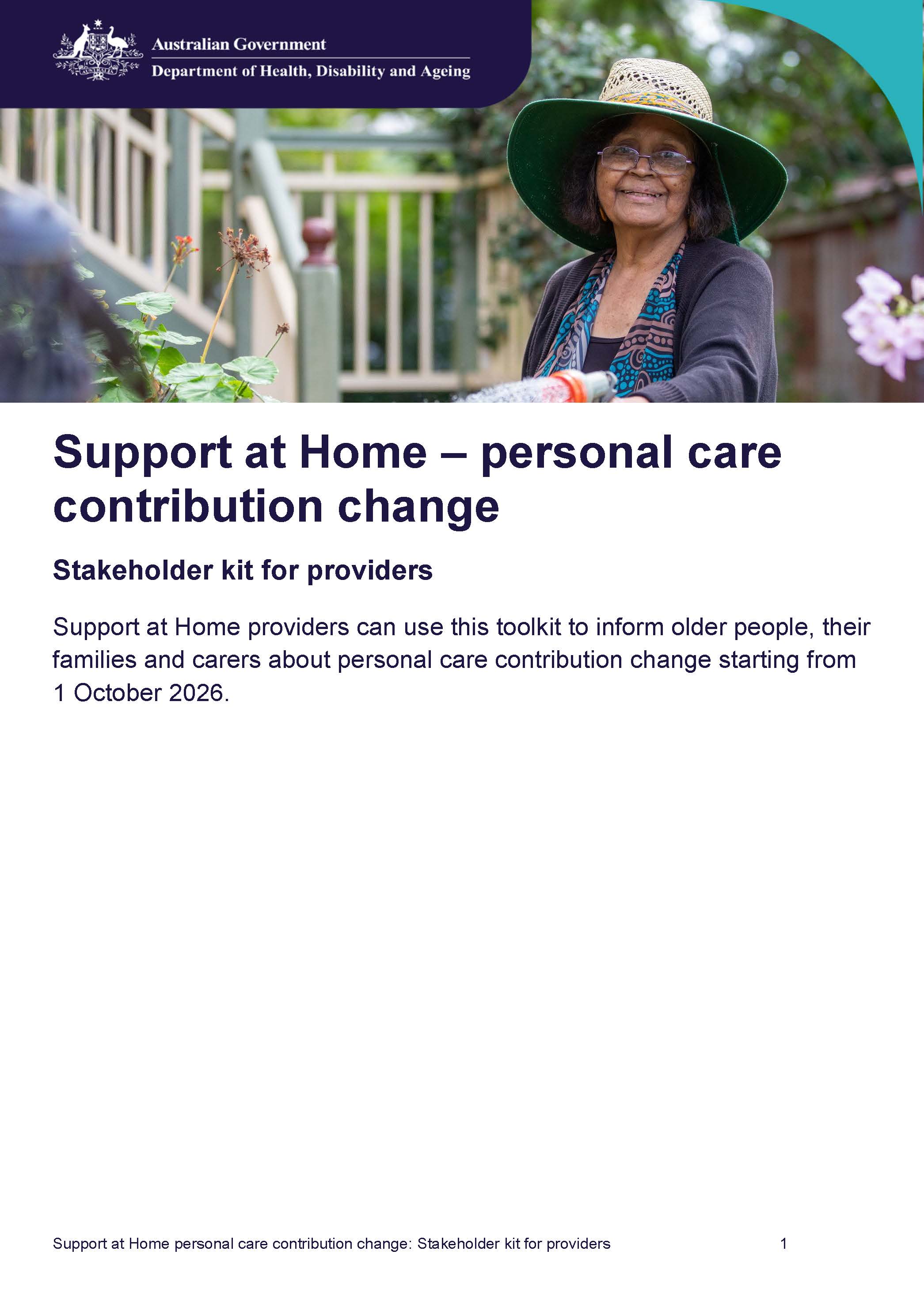
Support at Home personal care contribution change – Stakeholder kit for providers
Support at Home providers can use this toolkit to inform older people, their families and carers about personal care contribution change starting from 1 October 2026.

Commonwealth Home Support Program (CHSP) extended
The Commonwealth Home Support Program (CHSP) grant funding will be extended for another 2 years to 30 June 2029. This fact sheet is about the extension to CHSP.

An open letter to Commonwealth Home Support Program Providers
An open letter about the extension of the Commonwealth Home Support Program (CHSP) from Health and Ageing Minister Mark Butler and Minister for Aged Care and Seniors Sam Rae.

Personal care contribution change – Easy Read
The Easy Read resource can be used to share information with older people about the personal care contribution change. It is written in easy-to-understand English and supports accessibility and information preferences.

Strengthened Aged Care Quality Standards
The Strengthened Aged Care Quality Standards were implemented under the Aged Care Act 2024 on 1 November 2025. The Aged Care Quality Standards set the standard for the safety and quality of aged care accessed by older people in Australia.

My Aged Care – Application for Emergency Residential Care or Residential Respite Care Form
This form is for approved providers who want to apply for residential care or residential respite care.

Training checklist – older people, their families and carers
Older people, their families and carers can download this checklist of training opportunities to keep track of their learning on the new Aged Care Act.

National Aged Care Advisory Council communique – 10 June 2026
The National Aged Care Advisory Council met on 10 June 2026 to discuss aged care reform priorities, including access, sustainability, consumer protections and implementation issues.

Changes to personal care information sessions for Support at Home providers – Presentation – 6 August 2026
This presentation is information sessions for aged care providers to ask questions and seek clarification about the personal care contribution changes. Representatives from the department and Services Australia attend these sessions.
Date last updated: