
Resources

National Cervical Screening Program – How to collect your own sample – Condensed
This is a visual guide to help people understand how to collect their own vaginal sample if they choose self-collection as a screening option for their Cervical Screening Test.

Condition Outcomes
The document summarises the outcomes of conditions identified through the pre-assessment process for Australia's Newborn Bloodspot Screening program. It displays this information as a table with condition name and the outcome of that condition.

National Lung Cancer Screening Program – Poster
Display this poster promoting the National Lung Cancer Screening Program to patients in your clinic.

National Cervical Screening Program – Poster
Display this poster promoting the National Cervical Screening Program to patients in your clinic.
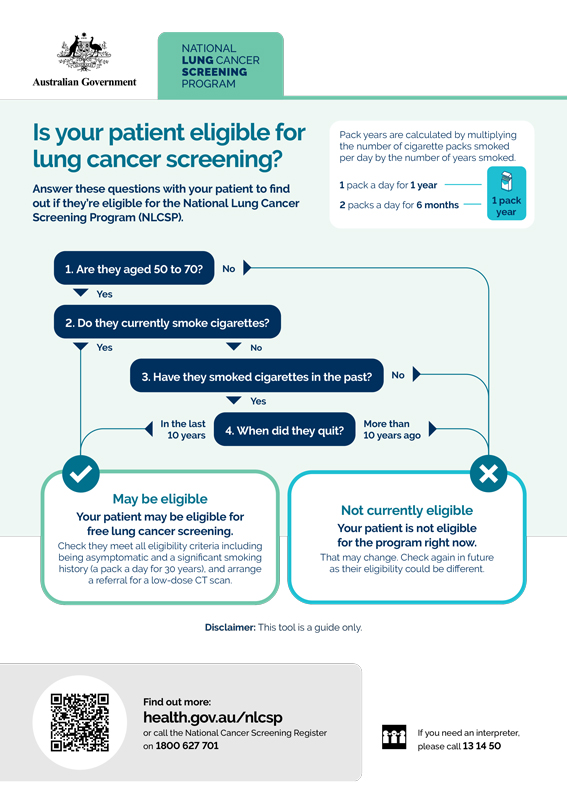
National Lung Cancer Screening Program Eligibility Tool
Answer these questions with your patient to find out if they’re eligible for the National Lung Cancer Screening Program.

Screening for Lung Cancer
This resource explains the National Lung Cancer Screening Program, including eligibility, how to access screening, and what happens during a low-dose CT scan.

BreastScreen Australia Program – Poster
Display this poster promoting the BreastScreen Australia Program to patients in your clinic.

Screening for Bowel Cancer
Learn how bowel cancer screening can help detect bowel cancer early and follow easy step-by-step instructions for completing the free home test kit.

Bowel Screening Colonoscopy Referral Checklist and Family Screening Strategies
This document provides guidance on the colonoscopy referral pathway and recommended strategies to enable the early detection of bowel cancer for people at risk of developing bowel cancer based on family history.

Screening for Breast Cancer
This resource explains the BreastScreen program and what happens during a screening mammogram, including how to book and what to expect at your appointment.

National Bowel Cancer Screening Program – Poster
Display this poster promoting the National Bowel Cancer Screening Program in your clinic.

Screening for Cervical Cancer
Learn how cervical screening helps prevent cervical cancer and find out about the different screening options, including self-collection, so you can choose the option that is right for you.

Your Cervical Screening Options
This brochure outlines the options available for cervical screening and how they work.

Referring patients for a low-dose CT scan under the National Lung Cancer Screening Program
A resource for GPs to follow when referring an eligible patient for the National Lung Cancer Screening Program.

Cancer Screening Resource Guide
Quick reference to additional resources not included within these resources to support conversations with patients.

Bowel Screening Decision Tool
Use this decision tool to identify if your patient should screen through the National Bowel Cancer Screening Program.

Cancer Screening Program Eligibility Reference Guide
Use this checklist to determine which cancer screening programs your patient may be eligible for during their appointment.

For sistas young and old 2 – National Cervical Screening Program – Poster
A poster for First Nations women about cervical screening

For sistas young and old 3 – National Cervical Screening Program – Poster
A poster for First Nations women about cervical screening

The screening process – National Cervical Screening Program – Brochure
A brochure for First Nations women explaining what happens during a Cervical Screening Test

Early changes everything 1 – National Cervical Screening Program – Poster
A poster for First Nations women about cervical screening

Deadly women screen 3 – National Cervical Screening Program – Poster
A poster for First Nations women about cervical screening

Deadly women screen 1 – National Cervical Screening Program – Poster
A poster for First Nations women about cervical screening

What is cervical screening? National Cervical Screening Program – Brochure
A brochure for First Nations women with general information on cervical screening

Cervical screening for younger women – National Cervical Screening Program – Brochure
A brochure for younger First Nations women with information on cervical screening
Date last updated: