About the OSR
The Online Services Report (OSR) collects national data about organisations which receive funding from the Indigenous Australians’ Health Programme (IAHP) to deliver comprehensive primary health care services to Aboriginal and Torres Strait Islander people.
The OSR dataset focuses on the characteristics of these services, along with the activities and services they provide. It provides a basic measure of activity, volume and coverage of services.
Health services submit aggregated organisation-level data on:
- staffing (both employed and visiting full-time equivalent staff)
- the types of health services provided
- the total number of individual clients seen
- client contacts by provider type
- episodes of care
- organisation governance, accreditation and information systems
This data collection aims to:
- identify key issues affecting Aboriginal and Torres Strait Islander primary health services and gaps in service delivery
- support continuous quality improvement (CQI) processes in health services.
The OSR dataset does not collect information on Indigenous health outcomes. This information is collected via the National Key Performance Indicators (nKPIs) and the Aboriginal and Torres Strait Islander Health Performance Framework (HPF).
Workflow
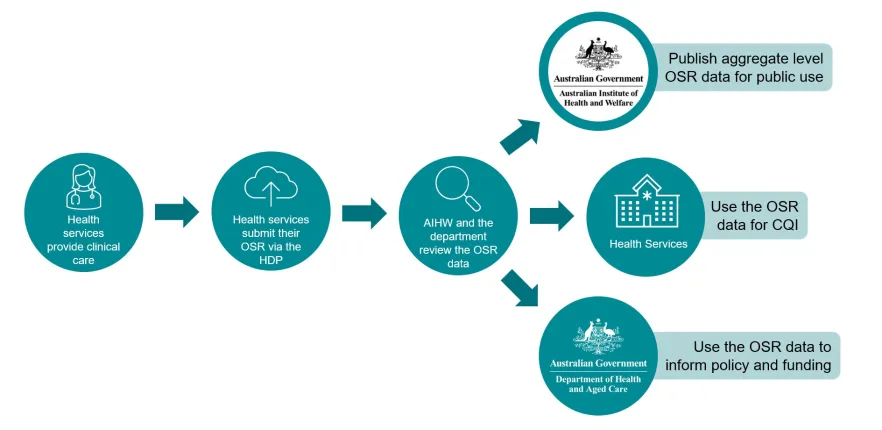
There four stages to the OSR submission and publication process:
- Health services provide clinical care to their patients.
- Health services submit their OSR data through the Health Data Portal every July.
- In collaboration with the AIHW, we review the OSR data in the HDP, ensuring it is as accurate as possible.
- The data is published by the AIHW as a national dataset, provided to health services for CQI – enabling services to make comparisons against other services and examine their performance over time, and used by the department to inform and evaluate policy and funding.
Uses of the data
The Commonwealth may use OSR data as specified in the agreement between each health service and the Department of Health, Disability and Aging. They can use OSR data to:
- monitor the activity of health services
- identify areas of need
- inform policy development and program delivery
- support continuous quality improvement
- measure service delivery
- improve service delivery
- improve health outcomes
- support progress towards Closing the Gap targets
- reduce the burden of reporting
- inform funding allocations
- brief the responsible Minister.
History and redesign
The AIHW reviewed the OSR data collection in 2019, and consulted extensively with the First Nations health sector. We further refined the Health Data Portal’s OSR capability based on the review’s recommendations and information gathered during portal co-design workshops. Key themes were to:
- reduce duplication and streamline the reporting wherever possible
- restructure and streamline the OSR into a small number of sections, with related items grouped together
- pre-populate items from the previous year’s report wherever possible
- make it easier for services to input workforce full-time equivalent information.
Future improvements
The OSR and nKPI collections are reviewed every five years by the Health Services Data Advisory Group to ensure that they remain fit for purpose while minimising health services’ reporting burden.
The latest review was conducted during 2025-2026. The review examined the appropriateness, usefulness, efficiency and governance of the collections, the burden they place on First Nations Primary Health Care (PHC) services, and how they can be strengthened in the context of Indigenous Data Sovereignty principles, broader national digital health reform, and the Closing the Gap Priority Reforms, in particular Priority Reform 4 relating to shared access to data and information at a regional level. Implementation of the review recommendations is ongoing, with a program of work underway to strengthen the collections, enhance data governance arrangements, reduce reporting burden, and improve the accessibility and use of data for First Nations communities and stakeholders.