
Filter results
You can narrow down the results using the filters
Audience
Topics
Our work
Diseases
11914 results
-

Newborn bloodspot screening (NBS) – National implementation timeframes for new conditions fact sheet
This fact sheet outlines the key steps and timeframes for adding new conditions to NBS programs to support the safe and consistent expansion of NBS in Australia. -

Assistive Technology and Home Modifications list (AT-HM list)
This document outlines the products, equipment and home modifications that eligible participants can access through the Assistive Technology and Home Modifications (AT-HM) Scheme. -

New arrangements for nitisinone (Orfadin®) – Treatment of hereditary tyrosinaemia type 1 – information for patients
This fact sheet is for current and future patients with hereditary tyrosinaemia type 1 explaining how a treatment for this condition, nitisinone (Orfadin®), will be transitioning from the Life Saving Drugs Program to the PBS. It provides further clarity on future access arrangements via the PBS. -

New arrangements for nitisinone (Orfadin®) – information for prescribers
This fact sheet is for current prescribers (treating physicians) with patients requiring treatment for hereditary tyrosinaemia type 1. It explains how a treatment for this condition, nitisinone (Orfadin®), will be transitioning from the Life Saving Drugs Program to the PBS. -

2026-27 – Aged Care Financial Report Non-uploadable template
The Aged Care Financial Report Non-uploadable template outlines the information aged care providers must report to meet annual financial, prudential and care reporting obligations, including residential aged care, Support at Home and related reporting requirements. -

2026-27 – Aged Care Financial Report Data Definitions
The Aged Care Financial Report (ACFR) Definitions 2026-27 explains reporting requirements, data definitions, legislative obligations, and key changes for the 2026-27 reporting year. -

Miscarriage Matters – Fact sheet 3 – Understanding how experiences of miscarriage can be different
What it is like to experience a miscarriage. -

Miscarriage Matters – Fact sheet 1 – What you can say or do
A guide to showing support. -

Miscarriage Matters – Fact sheet 2 – Learn the facts about miscarriage
What is miscarriage and why does it happen. -

Assignment of Medicare Benefits for Bulk Billing – Frequently Asked Questions
These frequently asked questions will help medical practitioners, administrative staff in medical practices and hospitals, and software vendors to understand and meet their obligations when claiming bulk billing under Medicare. -

Report on interactions between Health and the tobacco industry
We have obligations under the World Health Organization Framework Convention on Tobacco Control. Part of these is to report on our interactions with the tobacco industry. -

Aged care volunteering and the Aged Care Volunteer Visitors Scheme (ACVVS) booklet
This booklet has information about aged care volunteering and the ACVVS for potential and current volunteers, volunteer managers and providers. -

Residential aged care homes and the Aged Care Volunteer Visitors Scheme (ACVVS)
This fact sheet outlines the benefits, roles and responsibilities of the Aged Care Volunteer Visitors Scheme (ACVVS) for residential aged care providers. -

Support at Home providers and the Aged Care Volunteer Visitors Scheme (ACVVS)
This fact sheet outlines the benefits, roles and responsibilities of the Aged Care Volunteer Visitors Scheme (ACVVS) for Support at Home providers. -
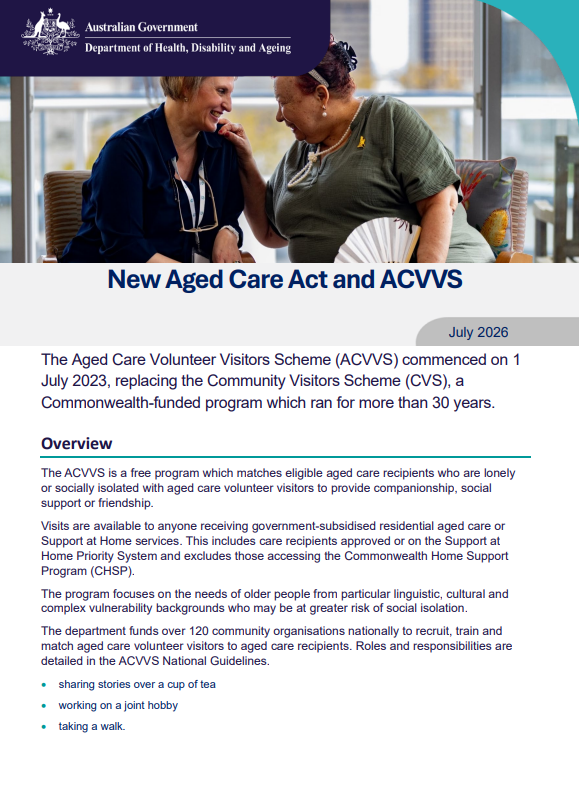
New Aged Care Act and ACVVS
This fact sheet outlines the benefits, roles and responsibilities of the Aged Care Volunteer Visitors Scheme (ACVVS) and the New Aged Care Act. -

FAQs on the consideration of sex, gender, variations of sex characteristics and sexual orientation in health and medical research
Information for Medical Research Future Fund and National Health and Medical Research Council applicants on how to account for sex, gender, variations of sex characteristics and sexual orientation in their research. -
Supporting Living Organ Donors Program Guidelines
This publication guides donors and their employers on the Supporting Living Organ Donors Program. It has information on the Program, including how to claim and what to include in your application. -

Letter to all Australians turning 50 about dementia risk
In July 2026 the Australian Government sent a letter to all people living in Australia who turned 50 in the year to 30 June 2026. The letter outlines things that can be done to reduce dementia risk. -

Workforce Incentive Program – Practice Stream (WIP-PS) frequently asked questions
This document provides general practices and other stakeholders with additional information about the Workforce Incentive Program – Practice Stream (WIP-PS). It answers some frequently asked questions about the program. -

National Disability Insurance Scheme Amendment (Integrity and Safeguarding) Bill 2025 – NDIA Measures fact sheet
Learn about the NDIA measures in the National Disability Insurance Scheme Amendment (Integrity and Safeguarding) Act 2026 that relate to withdrawing from the NDIS, electronic claims forms and plan variations. -

Securing the NDIS for future generations timeline
This timeline outlines the key dates for implementing the Government’s plan to secure the future of the NDIS. This includes when legislation will be introduced, when consultation will occur and when changes for participants and providers will begin. -
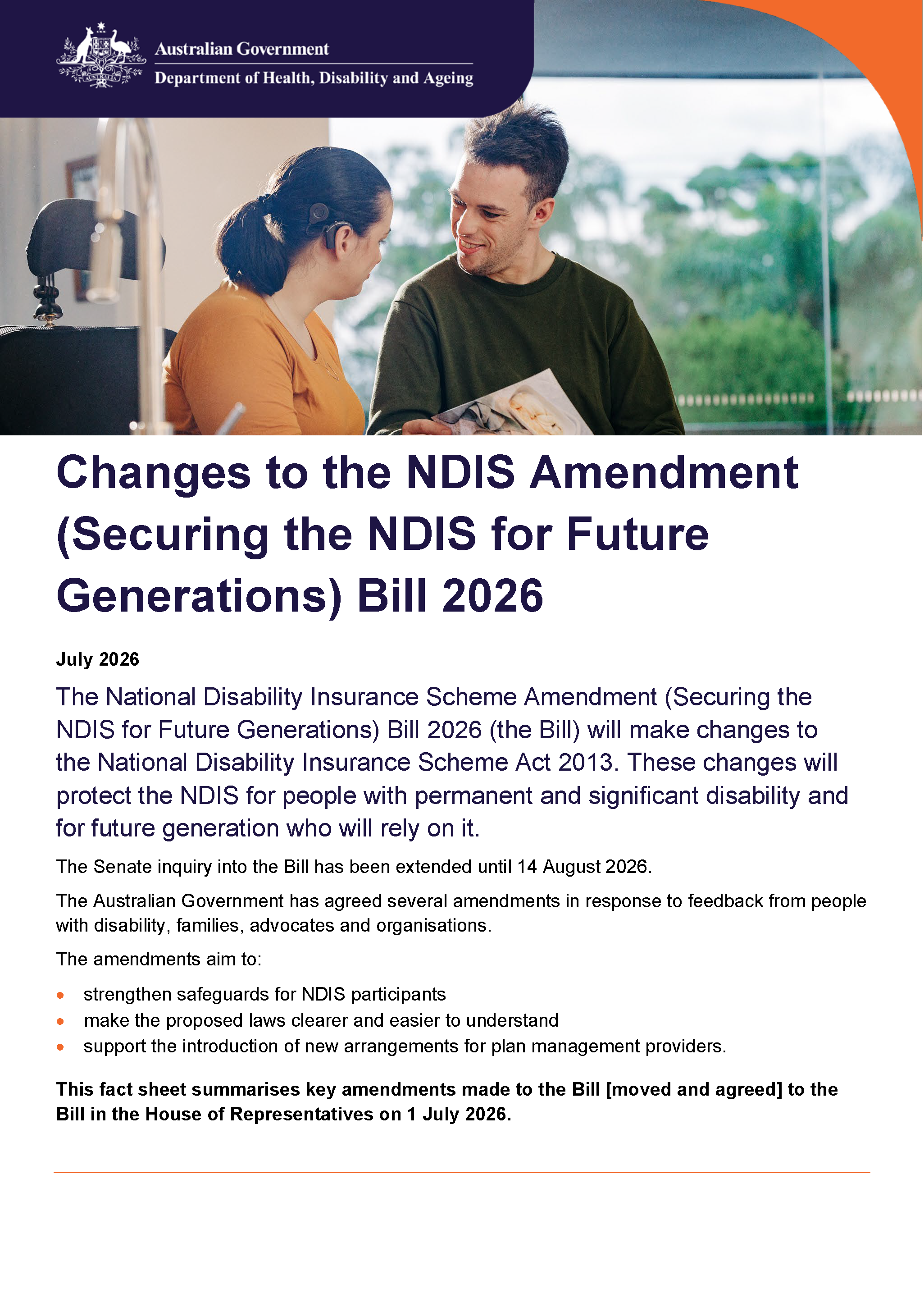
Changes to the NDIS Amendment (Securing the NDIS for Future Generations) Bill 2026 – fact sheet
The National Disability Insurance Scheme Amendment (Securing the NDIS for Future Generations) Bill 2026 will make changes to the National Disability Insurance Scheme Act 2013. This fact sheet is a summary of recent amendments agreed to in response to feedback.
-

Disability Support for Older Australians Program manual – Appendix C – How to fill out the ISP template
Information to help Disability Support for Older Australians (DSOA) Service Coordinators fill out the Individual Support Package (ISP) template for their DSOA clients. -

Disability Support for Older Australians Program and Aged Care Services fact sheet – For clients
Information for clients regarding the interface between the Disability Support for Older Australians (DSOA) Program and aged care services. -

Disability Support for Older Australians Program and Aged Care Services fact sheet – For Assessors
Information for aged care assessors regarding the interface between the Disability Support for Older Australians (DSOA) Program and aged care services.