
Changes to the NDIS new framework planning
In 2024, the Australian Parliament changed the NDIS Act. These changes set the direction for improving the NDIS. To put them into practice, we will update some existing rules and introduce some new NDIS rules. More details can be found in the table of new framework planning rules.
All NDIS participants aged 18 years and over will gradually move to new framework plans from April 2027 to 31 December 2030. The changes will happen in stages, so many participants will not notice any difference at first.
Only people who are already NDIS participants can take part in the new framework planning process. There is a separate process to apply to become an NDIS participant and get access to the NDIS.
We are working with state and territory governments, the National Disability Insurance Agency (NDIA) and the disability community to develop the new framework planning approach.
We consulted on new framework planning rules in early 2026. Further consultation will occur from August 2026. Stay up to date through our Consultation Hub.
We will use your feedback to help inform the new framework planning rules and other improvements over time.
Why we’re creating new framework plans
We heard from the NDIS Review that to make the NDIS more person-centred, we need:
- clearer processes for assessments and planning
- more transparent decision-making for funding
- greater flexibility in plans.
Proposed direction for new framework planning
We plan to have 4 steps in the participant journey for new framework planning:
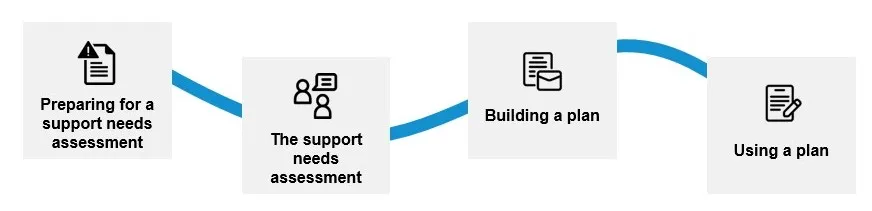
Step 1: Preparing for a support needs assessment
The NDIA contacts a participant to provide information to help prepare for the support needs assessment.
Step 2: The support needs assessment
Participants meet an NDIA assessor to discuss their daily life, support needs and preferences. The assessor submits the Support Needs Assessment report to the NDIA.
Step 3: Building a plan
The NDIA uses the report to structure the plan and create a total funding amount (NDIS plan budget). Participants receive the report and their NDIS plan to explain how their budget was created.
Step 4: Using a plan
Participants have the option of an implementation meeting. Participants can use the NDIS Supports list to choose, purchase and claim for supports with their new plan.
Rules related to each step
The Australian Government and state and territory governments will develop a set of rules for each of the steps within the new framework planning process.
This will increase understanding of how plans and budgets are generated, improving transparency, and visibility.
| Step | Related rules | These rules outline: |
|---|---|---|
| 1. Preparing for a support needs assessment | Notice to have a new framework plan (s32B(2)) |
|
| 2. The support needs assessment | Support Needs Assessment (s32L(2)) Needs Assessment Report (s32L(6)) Replacement Needs Assessment (s32L(7A)) | The support needs assessment:
|
| 3. Building a plan | Budget method (s32K) Stated supports (s32E(4)) Funding periods (ss32F(2)-(4) and 32J) Funding periods – exemptions (ss32G(3)-(5) and 32J) Restrictions of how flexible funding is spent (s32F(6)-(7)) Requirements for receiving a service or buying supports (ss32H(2)(d) and 32J)) |
|
| 4. Using a plan | NDIS supports (s10) |
|
How to get involved
Contact us for information or to share feedback about the new framework planning rules or Disability Update newsletter to stay up to date.

NDIS Consultations
Resources
