
About the changes
The NDIS plays a critical role in supporting people with permanent and significant disability, but it continues to grow at a far higher rate than any other comparable program.
The scale and distorted market structure of the NDIS are too often not providing high quality care to participants themselves. Costs are continuing to rise rapidly, driven by plan inflation and weaknesses in how the system currently operates.
If left unchecked, this puts the long-term sustainability of the NDIS – and its ability to support future generations – at risk.
The National Disability Insurance Scheme Amendment (Securing the NDIS for Future Generations) Bill was passed by the Parliament on 19 August 2026. The Bill received Royal Assent on 20 August 2026 and became the National Disability Insurance Scheme Amendment (Securing the NDIS for Future Generations) Act 2026.
Further reforms will still be needed to the NDIS so it can support people with a disability and their families and continue to transform their lives.
The government is committed to engaging with the disability community and states and territories on longer-term reforms.
Securing the NDIS for future generations timeline
The Securing the NDIS for future generations reform timeline outlines the key dates for implementing the Government’s plan to secure the future of the NDIS.
Priorities to secure the future of the NDIS
The government’s plan to secure the future of the NDIS will be delivered through 4 pillars:
- Fighting fraud and stopping rorts
- Slowing rapid costs increases
- Clearer eligibility requirements
- Delivering quality services and support to participants
These changes build on work underway to implement critical recommendations made by the Independent Review into the NDIS and the Royal Commission into Violence, Abuse, Neglect and Exploitation of People with Disability.
What is changing
Returning the NDIS to its original intent
The NDIS was established to support people with permanent and significant disability, but its scope has expanded to cover many Australians with less significant support needs.
In line with the original intent of the NDIS, access will be based on a significant reduction in a person’s functional capacity that impacts their day-to-day living.
A lack of clarity about what supports are considered reasonable and necessary has also led to confusion, inconsistency and a broadening in supports funded by the NDIS over time. This has also created a gap between what supports participants want and what the NDIS can deliver.
To address this we will:
- reinforce the boundary between the NDIS and mainstream services.
- more consistently assess if the NDIS is the appropriate system of support and if treatment can alleviate or remedy an impairment.
- strengthen guidance around what is reasonable and necessary.
- introduce standardised, evidence-based assessments of a person’s functional capacity to determine access to the NDIS.
- remove diagnosis lists as the means of entry to the NDIS.
- end plan rollovers and stop unspent funds being rolled over to ensure plans align with reasonable and necessary decision making.
- tighten the criteria around unscheduled reassessment requests, while ensuring people with significant changes in support needs can still request plan variations.
New framework planning will also deliver more equitable and consistent participant budgets through a new support needs assessment process and budget method.
Following consultation with people with disability and their families, carers and advocates, the rollout of new framework planning will be delayed until 1 April 2027. This will allow more time to listen to feedback, test proposed rules and processes, and share more detailed information about the transition.
Next steps:
- Introduce legislation to enable these changes.
- Establish a Technical Advisory Group to provide advice to government on an appropriate threshold and assessments for substantially reduced functional capacity and engage with the community and states and territories
- Tighter criteria for unscheduled plan reassessments will commence 7 days following Royal Assent of the legislation.
- Tighter assessment of reasonable and necessary supports for new entrants, plan reassessment for existing participants and plan renewal changes will be progressively implemented from 1 February 2027.
- Participants will start to transition to new framework planning from 1 April 2027.
- Changes to the boundaries between the NDIS and mainstream systems will apply to prospective participants from 1 January 2028, with current participants reassessed over a transition period.
Delivering genuine social and community participation
The NDIS was built on the promise of inclusion. It was meant to act as a framework that opened society up for people with a disability.
The current way the NDIS approaches social and community participation means the programs which once provided real opportunities for connection have been allowed to wither. We will put the community back into community participation.
To do this we will:
- establish a $200 million fund – the Inclusive Communities Fund – to rebuild capability among community organisations to host genuine participation activities.
- re-set participant budgets for social, civic and community participation and capacity building daily activities.
These changes will not impact supports that are essential to the critical care and daily living needs of participants. The changes will be implemented under existing planning arrangements, ahead of the introduction of new framework planning.
Next steps:
- Introduce legislation to enable these changes.
- Participant supports budgets for social, civic and community participation supports and capacity building daily activities will be progressively adjusted from 1 October 2026.
Improving the quality of providers
Policy settings have not encouraged transparency and innovation in NDIS markets and in some cases have resulted in provider viability challenges, variable quality, and poor outcomes for some participants.
We are addressing pricing and the design and delivery of plan management, support coordination and home and living supports to improve quality, encourage innovation and be more responsive to participant needs.
To do this we will:
- transfer responsibility for pricing decisions to the Minister for Disability and the NDIS.
- commence consultation on differentiated pricing for unregistered providers delivering social civic and community participation, capacity building daily activities, and assisted daily living.
- commission a panel of plan management providers to improve service quality and integrity standards and reduce fraud.
- commission a new, more efficient support coordination and connection function.
- commence consultation and design of a commissioning approach for home and living supports for Supported Independent Living (SIL) participants who need 24/7 support to ensure participants receive the best supports and address provider viability challenges.
Next steps:
- Introduce legislation to enable these changes.
- Consultation on commissioning home and living supports will begin in July 2026.
- The new plan management approach will be implemented from 1 October 2027, beginning with a 6 month transition period.
- The newly commissioned support coordination function will begin from 1 July 2028.
Tackling fraud and non-compliance
Fraud and non-compliance undermine the social licence of the NDIS and has a direct and devastating impact on the lives of participants and their families, leading to lower quality services, exploitation and harm.
We are making a suite of changes to improve oversight of providers and claims and strengthen controls to protect participants and the NDIS from exploitation.
To do this we will:
- expand mandatory registration of providers delivering support to participants who are most at risk of abuse and/or exploitation.
- introduce a new enrolment system with a minimum basic level of identifiable information on most NDIS providers.
- increase evidence required for payments for NDIS supports, including payments at point of service.
- strengthen the NDIA’s investigative and enforcement capabilities and introduce new regulatory controls to address fraud and non-compliance.
- improve how information is collected and monitored for faster and more targeted responses to fraud and suspicious behaviour.
- take further steps to reduce conflicts of interest.
Next steps:
- Introduce legislation to enable these changes.
- Reforms to strengthen powers for the NDIS Quality and Safeguards Commission and NDIA will be introduced over the next 18 months.
- Expansion of provider registration will commence from July 2027, with full implementation by the end of 2030.
- Uplift to NDIS claims and payments systems will begin from July 2026 and will be rolled out by the end of 2030.
Who the changes will affect
The actions we are taking may impact people in different ways from participants to families and carers, providers and the workers who deliver care and support services.
More information will be available to help explain what the changes mean for you and when they will happen. Changes will happen over time and we will let you know first.
Who we work with
We know more changes will be needed and we’ll continue to engage with the disability community and sector on longer term reforms so the NDIS remains fairer, safer and sustainable well into the future.
NDIS Reform Advisory Committee | Australian Government Department of Health, Disability and Ageing
NDIS Evidence Advisory Committee | Australian Government Department of Health, Disability and Ageing
Industry Chief Executive Forum | NDIS
Independent Advisory Council | NDIS
Learn more
Record funding for public hospitals and disability reform | Prime Minister of Australia
Working together to deliver the NDIS | NDIS Review
New framework planning | Australian Government Department of Health, Disability and Ageing
Securing the NDIS for future generations - Auslan
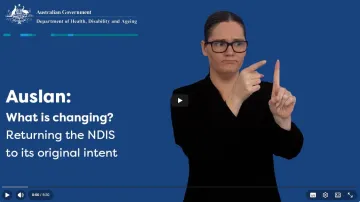
Securing the NDIS for future generations
Fact sheet and Easy Read
