
Registered nurses (RNs) are the largest group of healthcare workers in Australia. Enabling suitably qualified and endorsed RNs to prescribe certain medicines can improve access to timely, affordable, and safe healthcare. This reform supports recommendations by the Scope of Practice Review, a major element of the Australian Government’s comprehensive reforms to strengthen Medicare and the health system.
What is Designated RN Prescribing
Designated RN prescribing allows RNs who meet the Nursing and Midwifery Board of Australia’s (NMBA) requirements to prescribe scheduled medicines in partnership with an authorised health practitioner. This must be under an approved prescribing agreement and within relevant clinical governance, professional and legislative requirements.
What nurses need to know
Only RNs who are endorsed by the NMBA may prescribe.
The NMBA released the Endorsement for scheduled medicines - designated registered nurse prescriber standard on 30 September 2025. It enables registered nurses to prescribe Schedule 2, 3, 4 and 8 medicines in partnership with an authorised health practitioner such as a medical practitioner or nurse practitioner.
A designated RN prescriber must have an active prescribing agreement with an authorised health practitioner and must practise within:
- their agreed scope
- local clinical governance arrangements
- relevant state or territory medicines and poisons legislation.
Who can become a Designated RN Prescriber
To be eligible for endorsement, an RN must:
- hold current general registration as a registered nurse, with no conditions or undertakings relevant to the endorsement
- have at least 5,000 hours of clinical experience within the previous six years, equivalent to three years of full-time experience
- have completed a NMBA-approved program of study leading to endorsement, or completed equivalent units approved by the NMBA.
Read more about how to prepare to be a Designated RN Prescriber.
How the Prescribing Model Works
To prescribe as a designated RN prescriber, an endorsed registered nurse must:
- be endorsed by the NMBA for scheduled medicines as a designated RN prescriber
- have an active prescribing agreement with an authorised health practitioner that is approved by their employer or health service
- complete, or be undertaking, a six-month clinical mentorship with an authorised health practitioner to support safe prescribing practice
- practise within an appropriate clinical governance framework
- comply with the Nursing and Midwifery Board of Australia standard, associated guidelines, relevant national requirements and state or territory legislation.
Prescribing Agreement and Clinical Mentorship
An active prescribing agreement is required to practice as a designated RN prescriber. A prescribing agreement is a formal written agreement between the designated RN prescriber and an authorised health practitioner. It sets out the prescribing partnership, the clinical context, and the medicines and conditions relevant to the RNs prescribing practice.
A six-month clinical mentorship with an authorised health practitioner is required after endorsement. The mentorship supports the RN to develop confidence and competence in prescribing within their scope of practice.
After broad consultation, the Designated RN Prescribing Implementation Oversight Group (IOG) has developed national templates for the prescribing agreement and clinical mentorship agreement. These templates can be adapted to suit local clinical and governance requirements.
Templates
Please note: State and territory designated RN prescribing websites will have branded versions of these templates.
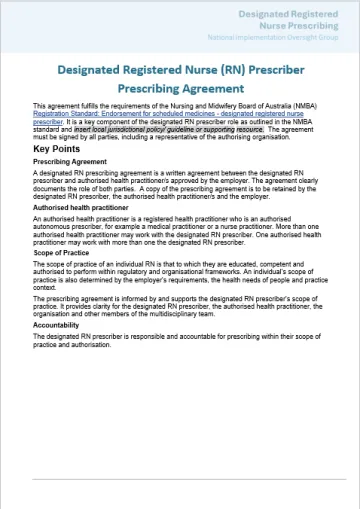
Designated Registered Nurse Prescriber - Prescribing Agreement template

Designated Registered Nurse Prescriber - Clinical Mentorship Agreement template
Information for software vendors
Supporting implementation of Designated RN Prescribing
Software vendors play an important role in supporting the implementation of designated RN prescribing. Key changes include support for the new designated RN prescriber type and prescriber code, updated PBS Schedule data, and updates to electronic prescribing systems. Existing PBS claiming arrangements and core interfaces remain unchanged.

Designated Registered Nurse Prescribing Vendor Resource Document
