
Pharmaceutical Benefits Scheme and Prescriber Number Registration
The Australian Government is progressing changes so that prescriptions written by eligible designated RN prescribers can attract subsidies under the Pharmaceutical Benefits Scheme (PBS).
The National Health Act 1953 has been amended which establishes authorised nurse prescribers as a PBS prescriber and enables them to prescribe certain pharmaceutical benefits under the PBS.
The Department of Health, Disability and Ageing has worked with the independent expert Pharmaceutical Benefits Advisory Committee (PBAC) to consider which medicines are suitable for designated RN prescribing under the PBS. Medicines are considered in tranches, with some medicines subject to restrictions.
PBS online will include an identifier for designated RN prescribers, alongside all other prescriber types.
Services Australia enables eligible nurse prescribers to apply to become authorised nurse prescribers and receive a prescriber number, giving them access to relevant PBS services.
Nurses can apply online through Health Professional Online Services (HPOS). A paper application option is also available where needed.
Services Australia has developed new and updated guidance, educational resources and support materials to help nurses complete the process.
- Health Professional Online Services (HPOS) Fundamentals
- Designated registered nurse prescriber
- Applying online to be recognised as an authorised nurse prescriber and receive a Pharmaceutical Benefits Scheme (PBS) prescriber number
PBAC Outcomes
The PBAC Outcomes page provides information and brief summaries of Pharmaceutical Benefits Advisory Committee outcomes, grouped by meeting date. Designated RN prescribing was considered at the May intracycle, July and September intracycle meetings.
PBAC Outcomes | Pharmaceutical Benefits Scheme (PBS)
- Recommendations made by the PBAC – May 2026 Intracycle meeting
- Recommendations made by the PBAC – July 2026
- Recommendations made by the PBAC – September 2026 Intracycle Meeting
Real Time Prescription Monitoring
Real time prescription monitoring (RTPM) gives prescribers and pharmacists access to information about a person’s prescribing and dispensing history for monitored medicines. This supports safer and more informed prescribing decisions.
Designated RN prescribers will be able to access RTPM when their state or territory enables access through local systems and processes. Requirements differ across states and territories, so designated RN prescribers must check and comply with the requirements that apply in their jurisdiction.
The Australian Digital Health Agency has more information about Real time prescription monitoring including State and territory RTPM contacts.
Designated RN Prescribers and Employer Readiness
Designated RN prescribing is expected to commence from October 2026 and will be implemented progressively as legislative, regulatory, system and operational readiness requirements are met.
As implementation may differ across jurisdictions and settings, nurses and employers should confirm that all regulatory, workplace, software, digital and clinical governance requirements are in place before prescribing begins.
Readiness activities may include the following, where relevant to the nurse’s role, scope of practice and local arrangements:
- Obtain NMBA endorsement and appropriate professional indemnity insurance.
- Establish a prescribing agreement with an authorised health practitioner.
- Prescribe within education, competence and scope of practice.
- Meet Commonwealth, state and territory legislative requirements.
- Complete any employer credentialling, authorisation and competency requirements.
- Review local policies, procedures and medication management frameworks.
- Obtain a PBS prescriber number where PBS prescribing is required.
- Ensure access to prescribing software and digital systems including real-time prescription monitoring.
- Confirm intended medicines can be prescribed under applicable jurisdictional and PBS arrangements.
- Confirm local clinical governance and escalation processes.
Designated RN Prescribing Implementation Oversight Group
The Designated Registered Nurse (RN) Prescribing Implementation Oversight Group (IOG) provides national leadership and coordination for the implementation of designated RN prescribing across Australia. The group brings together representatives from jurisdictions, regulatory agencies, education providers, and key stakeholders to support the safe, consistent and effective roll out of the reform.
Established in October 2025, the IOG oversees implementation activities that enable appropriately educated and endorsed designated RN prescribers to prescribe medicines as part of delivering safe, quality and timely healthcare to the Australian community. The group has met regularly since its establishment and continues to guide implementation as the reform progresses from planning to operational delivery.
The IOG also works closely with stakeholders to address implementation challenges and ensure feedback is incorporated into national resources and guidance materials.
The implementation of designated RN prescribing represents a significant workforce reform that will improve access to timely healthcare while maintaining patient safety and quality of care. The IOG will continue to provide national coordination and oversight as jurisdictions and health services prepare for designated RN prescribers to commence prescribing in approved settings across Australia.
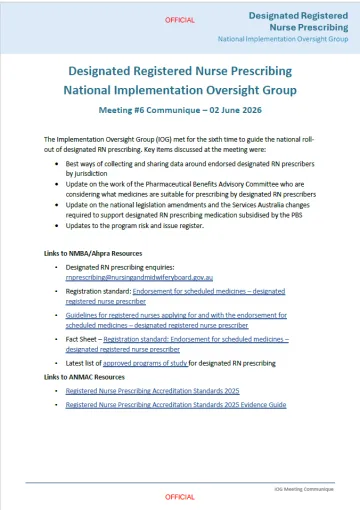
National Implementation Oversight Group communiques
Resources
State and territory designated RN prescribing webpages
- Tasmania
- Western Australia
- Victoria
- South Australia
- Northern Territory
- New South Wales
- Australian Capital Territory
Templates
More information
- NMBA Registration Standard, Guidelines and frequently asked questions
- NMBA approved programs of study for designated RN prescribing
- AHPRA National prescribing competencies framework underpinning RN prescribing training
- ANMAC Registered nurse prescribing accreditation standards.