
Filter results
You can narrow down the results using the filters
Audience
Topics
Our work
Diseases
11609 results
-

Screening strategies for people with a family history of bowel cancer
This document provides guidance about recommended strategies to enable the early detection of bowel cancer for people at risk of developing bowel cancer based on family history. -

Youth Specialist Care Centres model of care
The model of care provides a framework for Youth Specialist Care Centres to deliver multidisciplinary, longer-term support for young people aged 12 to 25 with severe or emerging mental health conditions and complex needs. -

headspace Plus model of care
This framework supports headspace centres delivering the headspace Plus model to provide enhanced multidisciplinary and specialist support for young people experiencing severe, intersecting or evolving mental health needs that require more intensive support. -

Specialisation Verification Framework
The final framework sets out the criteria for specialised care delivery. Aged care providers who deliver specific services that meet diverse needs may apply for specialisation verification. -

National Aboriginal and Torres Strait Islander Flexible Aged Care Program Manual
This manual is for aged care service providers who receive funding under the National Aboriginal and Torres Strait Islander Flexible Aged Care Program. It outlines the requirements of the program including service planning, staffing, health and safety, quality and advocacy. -

Bowel Cancer Screening Program Colonoscopy referral checklist
This document provides guidance on the bowel cancer screening colonoscopy referral pathway. -

Parents and children who are separated by forced adoption or removal – Specialisation Verification Evidence Form
This application form is used to apply for Specialisation Verification status for parents and children who are separated by forced adoption or removal. It aligns with the updated Specialisation Verification Framework. -

Lesbian, gay, bisexual, trans/transgender or intersex – Specialisation Verification Evidence Form
This application form is used to apply for Specialisation Verification status for lesbian, gay, bisexual, trans/transgender, intersex or other sexual orientations or gender diverse or bodily diverse people. It aligns with the updated Specialisation Verification Framework. -

People who live in rural, remote or very remote areas – Specialisation Verification Evidence Form
This application form is used to apply for Specialisation Verification status for people who live in rural, remote or very remote areas. It aligns with the updated Specialisation Verification Framework. -

Veterans or war widows – Specialisation Verification Evidence Form
This application form is used to apply for Specialisation Verification status for veterans and/or war widows. It aligns with the updated Specialisation Verification Framework. -

Care Leavers, including Forgotten Australians and former child migrants placed in out of home care – Specialisation Verification Evidence Form
This application form is used to apply for Specialisation Verification status for Care Leavers, including Forgotten Australians and former child migrants placed in out of home care. It aligns with the updated Specialisation Verification Framework. -

People from culturally, ethnically and linguistically diverse (CALD) backgrounds – Specialisation Verification Evidence Form
This application form is used to apply for Specialisation Verification status for people from culturally, ethnically and linguistically diverse backgrounds. It aligns with the updated Specialisation Verification Framework. -

People who are experiencing homelessness or at risk of experiencing homelessness – Specialisation Verification Evidence Form
This application form is used to apply for Specialisation Verification status for people who are experiencing homelessness or at risk of experiencing homelessness. It aligns with the updated Specialisation Verification Framework. -

Aboriginal and Torres Strait Islander Persons, including Stolen Generations – Specialisation Verification Evidence Form
This application form is used to apply for Specialisation Verification status for Aboriginal and Torres Strait Islander Persons, including Stolen Generations. It aligns with the updated Specialisation Verification Framework. -

People who are financially or socially disadvantaged – Specialisation Verification Evidence Form
This application form is used to apply for Specialisation Verification status for people who are financially or socially disadvantaged. It aligns with the updated Specialisation Verification Framework. -

Private Health Insurance clinical category classification and definitions 1 November 2026
This spreadsheet classifies MBS items by private health insurance clinical category or procedure type and includes MBS items effective 1 November 2026. -

Aged Care On-site Pharmacist Measure – Primary Health Network – Residential Aged Care Home Support Grant Program Guide
This document is designed to support Primary Health Networks (PHNs) that are participating in the Aged Care On-site Pharmacist Measure – Residential Aged Care Home Support Grant Program. -

National Immunisation Program schedule
This schedule provides recommended vaccines and schedule points under the National Immunisation Program. -

Technical Advisory Group for NDIS functional capacity – Communique – October 2026
Communiqué summarising key discussions, insights and outcomes from the Technical Advisory Group on NDIS Functional Capacity meeting held on 13 October 2026. -

Star Ratings quarterly data extract – October 2026
Service level Star Ratings data as at October 2026. -

Certification Statement – National Medicare Mental Health campaign
This certification statement, signed by Secretary Blair Comley on 25 September 2026, certifies that the National Medicare Mental Health campaign complies with relevant guidelines and policies. -

Influenza (flu) immunisation data – 1 March to 4 October 2026
Weekly report of year to date immunisation figures broken down by age groups and immunising provider types. Compares vaccination rates with the previous 3 years. -

Exposure draft Aged Care Amendment Rules 2026: Escalation Pathway
This is an exposure draft of an amendment to the Aged Care Rules 2025. The escalation pathway provides an additional review mechanism for exceptional circumstances where an older person's ageing-related needs may not be fully reflected through standard assessment arrangements. -

Position statement – The empowerment of women and girls in the Australian health system
The National Women’s Health Advisory Council, in partnership with the Australian Women’s Health Alliance, developed a position statement to support the empowerment of women and girls as a core principle in women’s health policy, research and practice across the health system. -
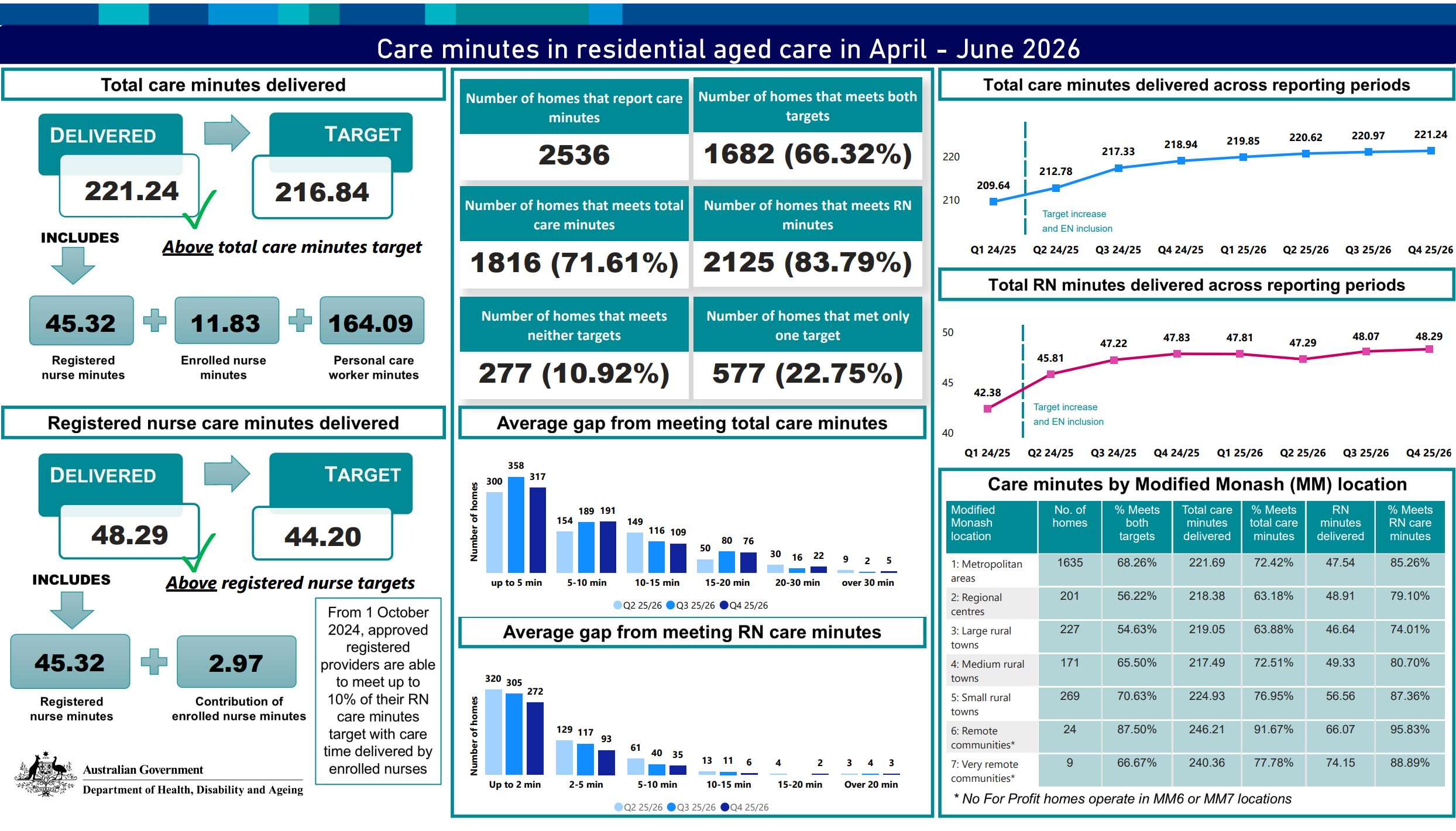
Care minutes in residential aged care dashboard
This dashboard provides users with high level information on care minutes in residential aged care.