
Filter results
You can narrow down the results using the filters
Audience
Topics
Our work
Diseases
11927 results
-

MyMedicare Program Guidelines
The MyMedicare Program Guidelines (the guidelines) provide clear guidance for practices, General Practitioners (GPs) and patients who wish to voluntarily register with the MyMedicare Program (the program). The guidelines also set out the program’s requirements, benefits and dispute processes. -

Workforce Incentive Program – Practice Stream (WIP-PS) fact sheet
This fact sheet provides information on the Workforce Incentive Program Practice Stream (WIP-PS) payment. -

Childhood vaccinations – Your questions answered – FAQ
Have any questions about immunisation or vaccinations? We have compiled answers to the most frequently asked questions about childhood vaccinations. -

COVID-19 vaccination – Local Government Area (LGA) – 1 July 2026
These reports list the percentage of people who have been vaccinated against COVID-19 by local government areas (LGA). -

COVID-19 vaccine rollout update – 01 July 2026
This presentation, delivered on 01 July 2026, contains an update to Australia's COVID-19 vaccine rollout. -

COVID-19 vaccination – vaccination data – 01 July 2026
These data files contain statistical data about Australia's COVID-19 vaccinations. -

Designated Registered Nurse Prescriber - Clinical Mentorship Agreement template
After endorsement, a designated registered nurse prescriber must complete a six-month period of clinical mentorship with an authorised health practitioner to build confidence and competence in prescribing. -

Designated Registered Nurse Prescriber - Prescribing Agreement template
Designated registered nurse prescribers must have an active prescribing agreement in place with an authorised health practitioner. A national prescribing template is available and can be adapted to local clinical and governance requirements. -

Designated Registered Nurse Precriber - Prescribing Agreement template
After endorsement, a designated registered nurse prescriber must complete a six-month period of clinical mentorship with an authorised health practitioner to build confidence and competence in prescribing. -

Changes to personal care information sessions for Support at Home providers – Presentation – 25 June 2026
View the presentation slides from the changes to personal care information session for Support at Home providers held on 25 June 2026. -

Changes to personal care information sessions for Support at Home providers – Presentation – 9 July 2026
View the presentation slides from the changes to personal care information session for Support at Home providers held on 9 July 2026. -

Technical Advisory Group for NDIS functional capacity – Communique – July 2026
The first meeting of the Technical Advisory Group for NDIS functional capacity was held on 9 July 2026. Read the communique, which summarises the meeting discussions and outcomes. -

MBS Review Advisory Committee communique – June 2026
This communique is published following each meeting of the MBS Review Advisory Committee (MRAC). It summarises the meeting outcomes, progress on current reviews and advice about upcoming reviews. -

Residents’ Experience Survey – participant privacy notice
This privacy notice explains who collects information and what happens to it as part of the Residents' Experience Survey. -
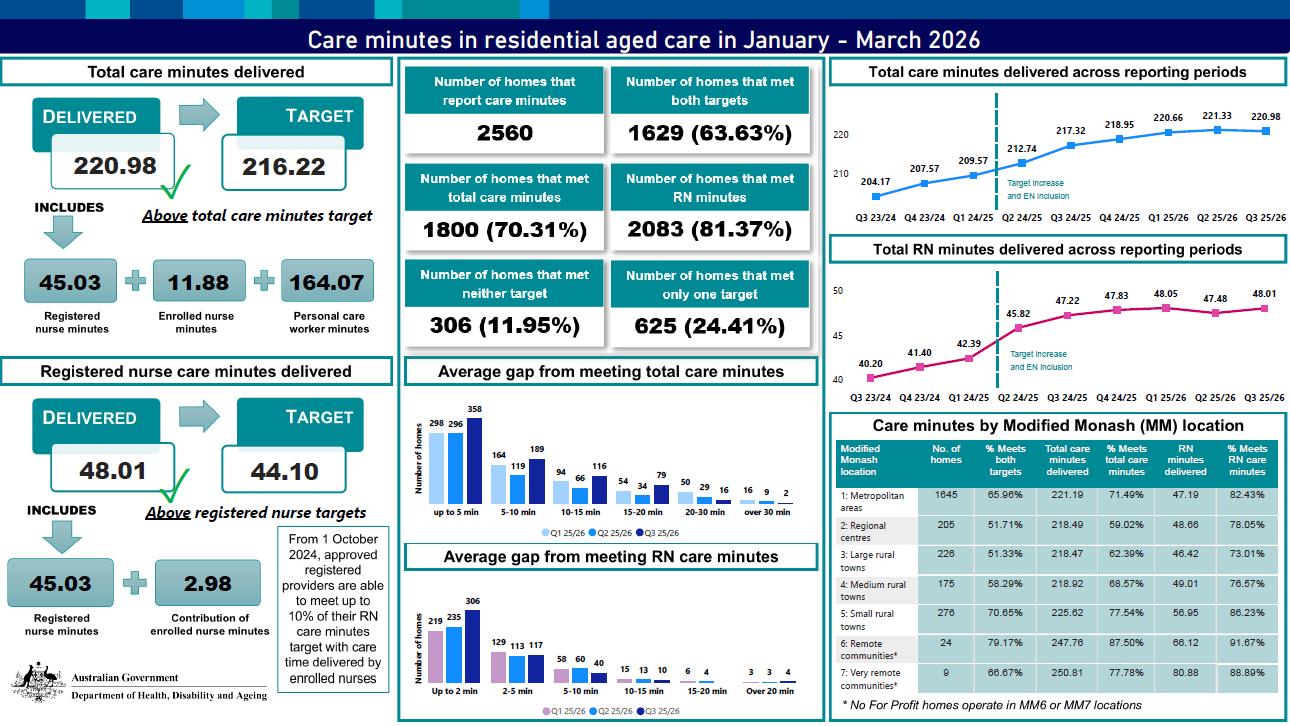
Care minutes in residential aged care dashboard
This dashboard provides users with high level information on care minutes in residential aged care. -

Reporting under the Public Health (Tobacco and Other Products) Act 2023: Tobacco product ingredients report
If you need to submit a report, you must submit in the form of this template. Details on how to complete the templates can be found in the introduction tab of each template. -

Reporting under the Public Health (Tobacco and Other Products) Act 2023: Tobacco product marketing and promotional expenditure report
If you need to submit a report, you must submit in the form of this template. Details on how to complete the templates can be found in the introduction tab of each template. -

Reporting under the Public Health (Tobacco and Other Products) Act 2023: Tobacco product volumes report
If you need to submit a report, you must submit in the form of this template. Details on how to complete the templates can be found in the introduction tab of each template. -

Privacy and your personal information: Public Health (Tobacco and Other Products) Act 2023
The Department of Health, Disability and Ageing (the department) administers the reporting and disclosure requirements in the Public Health (Tobacco and Other Products) Act 2023. -

Health Peak and Advisory Bodies Program round 4 grant opportunity (GO7902) feedback for applicants
This fact sheet provides general feedback for applicants to Round 4 of the Health Peak and Advisory Bodies Program grant opportunity. It highlights key observations from the grant application assessment process. -

Technical Advisory Group for NDIS functional capacity – Terms of reference
Read the terms of reference for the Technical Advisory Group for NDIS functional capacity, which will provide independent, expert advice to support reforms to National Disability Insurance Scheme (NDIS) access and eligibility. -
Government Response to the Interim First Nations Aged Care Commissioner’s Report
This document is the Australian Government Response to the Government Response to the Interim First Nations Aged Care Commissioner’s Report. -

DSOA Program manual – Appendix H – NDIS Registration Exemption Form
Disability Support for Older Australians (DSOA) Service Coordinators must use this form when applying for NDIS registration exemption under the DSOA Program. -
Disability Support for Older Australians Program – How to Complete a Change of Needs Application
This fact sheet provides information to assist Disability Support for Older Australians (DSOA) service coordinators with completing a change of needs application for DSOA clients. -
Disability Support for Older Australians Program manual
This program manual is a guide for Disability Support for Older Australians (DSOA) Program service coordinators and clients.