
Filter results
You can narrow down the results using the filters
Audience
Topics
Our work
Diseases
11447 results
-

End-of-Life Pathway form
This form is used to provide evidence of eligibility for the End-of-Life Pathway under the Support at Home program. -

Registered supporters in aged care brochure
This brochure provides information on the registered supporter role, under the new Aged Care Act, and is aimed at older people and those who support them. -

Australian Public Service employee census 2025
This collection provides the results of the 2025 Australian Public Service (APS) employee census, as well as our action plan. -

Assistive Technology over $15,000
This form is for people applying to access assistive technology over $15 000. -

Accessing the Multi-Purpose Service Program (MPSP) – Consumer fact sheet
If you are an older person living in a rural or remote part of Australia, you may be able to access services through the Multi-Purpose Service Program (MPSP). -

Leaving the Multi-Purpose Service Program (MPSP) – Consumer fact sheet
If you decide to leave the Multi-Purpose Service Program (MPSP) and access other aged care services, you might need to wait for services to become available and could pay higher fees. -

Accessing the Multi-Purpose Service Program (MPSP) – Provider fact sheet
This fact sheet provides guidance for aged care providers on access to aged care services under the Multi-Purpose Service Program (MPSP) when the new Aged Care Act (the new Act) starts from 1 November 2025. -

Reporting by Multi-Purpose Service Program (MPSP) providers – Provider fact sheet
Under the new Aged Care Act (the new Act), you must keep records and report on the services you provide under the MPSP. -

Regulation of the Multi-Purpose Service Program (MPSP) – Provider fact sheet
Aged care services delivered under the in the Multi-Purpose Service Program (MPSP) are regulated to ensure providers meet their obligations under the new Aged Care Act (the new Act) and their MPSP agreements. -

My Aged Care Assessment Consent Form
This form is to be used by assessors where system access is not available or appropriate for the aged care assessment setting at the triage, assessment and/or referral for services consent stages. -
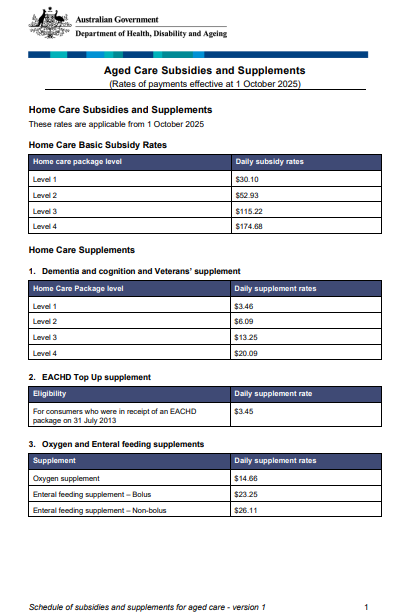
Schedule of Subsidies and Supplements for Aged Care (Before 1 November 2025)
View the schedules of subsidies and supplements for government-funded aged care under the Aged Care Act 1997. This includes daily rates for residential, flexible and home care until 31 October 2025. -
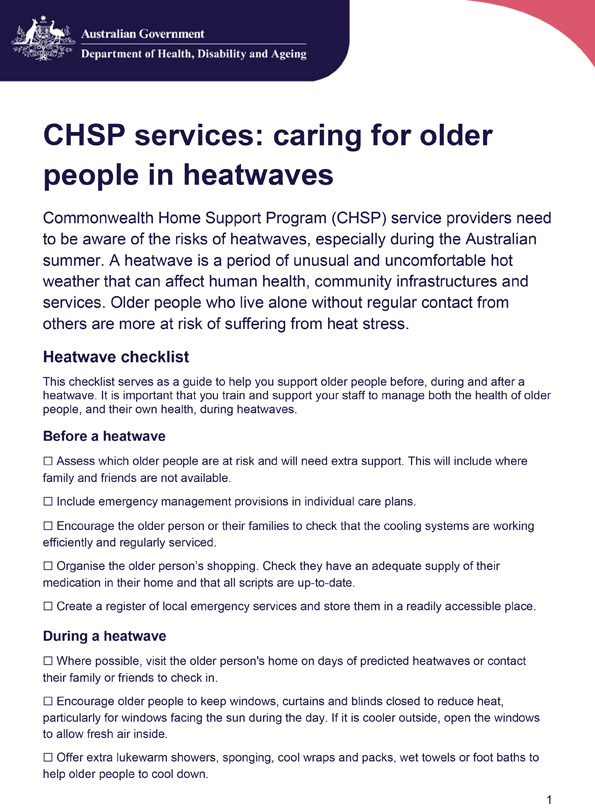
CHSP services: caring for older people in heatwaves
CHSP providers should assess risks, update care plans, and support older people before, during, and after heatwaves. Key actions include checking cooling, hydration, nutrition, monitoring health, and reviewing emergency plans. -
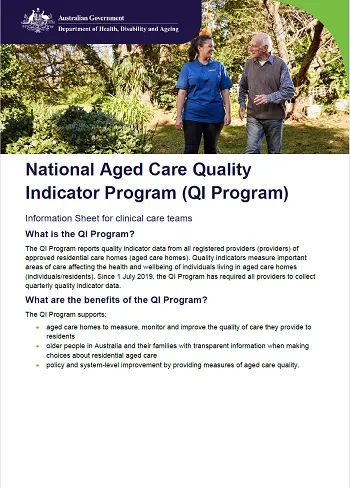
QI Program fact sheets
This collection of information sheets are for Australian Government-funded providers of residential aged care. The information sheets cover the definitions for each quality indicator and describes how the QI Program is relevant to them. -

Fact sheet for GPs and allied health professionals – QI Program
This fact sheet is for Australian Government-funded residential aged care . It covers the definition for each quality indicator and describes how the QI Program is relevant to them. -

Fact sheet for older people and their families
This fact sheet is for Australian Government-funded residential aged care. It covers the definition for each quality indicator and describes how the QI Program is relevant to them. -

Fact sheet for board directors and senior executives
This fact sheet is for Australian Government-funded providers of residential aged care. It covers the definition for each quality indicator and describes how the QI Program is relevant to them. -

QI Program quick reference guide – Falls and major injury
This guide is for registered providers of approved residential care homes. It helps you understand and meet your obligations to collect and report data on falls and major injury for the QI Program. -

QI Program quick reference guide – Medication management – Antipsychotics
This guide is for registered providers of approved residential care homes. It helps you understand and meet your obligations to collect and report data on medication management – antipsychotics for the QI Program. -

QI Program quick reference guide – Pressure injuries
This guide is for registered providers of approved residential care homes. It helps you understand and meet your obligations to collect and report data on pressure injuries for the QI Program. -

QI Program quick reference guide – Unplanned weight loss
This guide is for registered providers of approved residential care homes. It helps you understand and meet your obligations to collect and report data on unplanned weight loss for the QI Program. -

QI Program quick reference guide – Restrictive practices
This guide is for registered providers of approved residential care homes. It helps you understand and meet your obligations to collect and report data on restrictive practices for the QI Program. -

QI Program quick reference guide – Medication management – Polypharmacy
This guide is for registered providers of approved residential care homes. It helps you understand and meet Your obligations to collect and report data on medication management – polypharmacy for the QI Program. -

Fact sheet for clinical care teams – QI Program
This information sheet is for Australian Government-funded providers of residential aged care. It covers the definition for each quality indicator and describes how the QI Program is relevant to them. -

National Aged Care Quality Indicator Program FAQs
This document is for registered providers of approved residential care homes (providers). The document details a range of frequently asked questions and answers to support providers to understand and meet the requirements of the QI Program. -

Better Access fact sheet – patients
This fact sheet gives patients with mental health issues an overview of the Better Access to Psychiatrists, Psychologists and General Practitioners through the MBS initiative.