
Filter results
You can narrow down the results using the filters
Audience
Publication type
Topics
Our work
Diseases
9438 results
-

Support at Home Payment Integrity Rolling Review – Cycle 1 summary report
This report outlines the findings and outcomes of Cycle 1 of the Support at Home Payment Integrity Rolling Review, which assured pricing transparency, evidence of delivery and compliance with monthly statement requirements. -

Joint report on MRFF and NHMRC funding from 2021-22 to 2024-25
This report outlines Medical Research Future Fund and National Health and Medical Research Council (NHMRC) funding from 2021-22 to 2024-25. This is a joint Department of Health, Disability and Ageing and NHMRC report. -

Council of Elders Communique – 5 and 6 August 2026
This communique summarises the Council of Elders’ August 2026 meeting, highlighting discussions on ageing well, aged care reforms, access to services, price transparency, Support at Home, and First Nations engagement. -
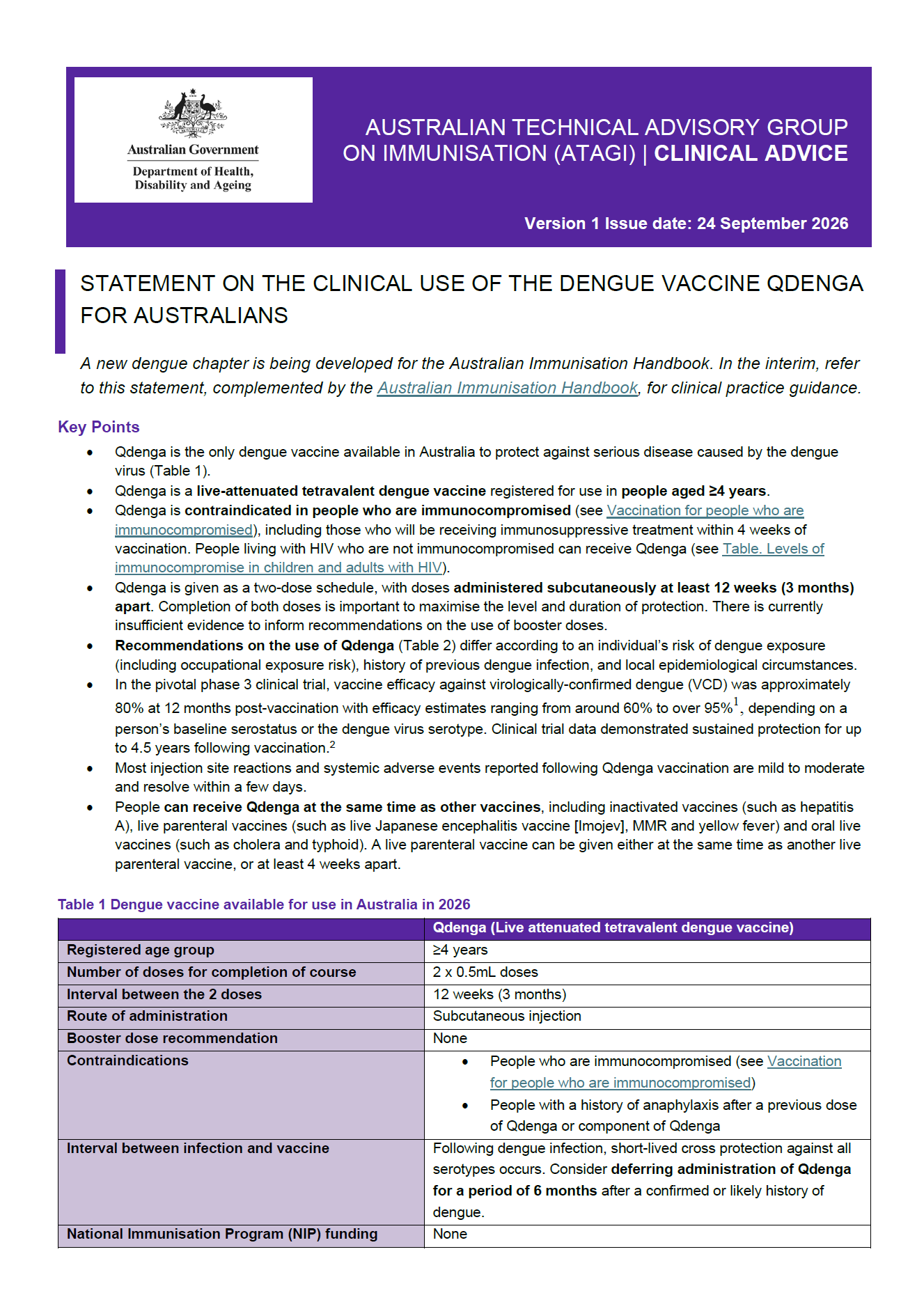
ATAGI statement on the Clinical use of the Dengue vaccine Qdenga for Australians
Australian Technical Advisory Group on Immunisation (ATAGI) advice regarding the Clinical use of QDenga for Australians. -

National Cervical Screening Program – How to collect your own sample – Condensed
This is a visual guide to help people understand how to collect their own vaginal sample if they choose self-collection as a screening option for their Cervical Screening Test. -

Electronic National Residential Medication Charts (eNRMC) – Conformance status tracker
The Department of Health, Disability and Ageing and the Australian Digital Health Agency have worked with eNRMC software vendors to ensure conformant eNRMC systems with electronic prescribing capability are available. -

Schedule of Subsidies and Supplements for Support at Home
The schedule lists the daily rates of subsidies and supplements for the Support at Home program. -

Support at Home program – classifications and budgets
This fact sheet provides an overview of the 8 ongoing classifications and budgets in the Support at Home program. -
GP Pathology Requesting Project Report
The GP Pathology Requesting Project aims to promote the clinically relevant use of pathology tests and assist GPs to reduce the potential for unintended harm to patients from identification of incidental findings that may lead to unnecessary treatment. -

Funding changes for NDIS supports – Safeguards for high support needs participants
Learn how the new NDIS plan variation pathway for high supports needs participants will work. Accessible versions of this information are available in Auslan and Easy Read. -

Funding changes for NDIS supports
Learn about upcoming changes to funding for social, economic and community participation and improved daily living skills supports, key safeguards, implementation timeframes and what participants need to know. Accessible versions of this information are available in Auslan and Easy Read. -

Electronic National Residential Medication Chart (eNRMC) – Transitional Arrangement extended to 31 March 2027
This fact sheet outlines the transition from the eNRMC Transitional Arrangement to conformant electronic prescribing systems, including key deadlines, ongoing PBS claiming arrangements, and actions residential aged care providers, prescribers and pharmacies should take before 1 April 2027. -

Translated Language Guides – Perimenopause and Menopause
Translated guides have been developed in 6 languages to help people understand and talk about perimenopause and menopause. -
Home-level care minutes performance in residential aged care
This provides information on care minutes performance for residential care homes by financial years. From 1 April 2026, quarterly performance will be used to calculate the care minutes supplement for non-specialised metropolitan homes. -

PHI 78/26 attachments - 2027 Private health insurance premium application form and templates
These attachments to PHI circular 78/26 are the 2027 private health insurance premium application form and templates. Attachment 1B was reissued on 15 October 2026 with a minor correction. -

Changes to personal care information sessions for Support at Home providers - Presentation - 17 September 2026
Provides guidance to Support at Home providers on expected impacts of the upcoming changes to personal care contribution arrangements, effective 1 October 2026 and how to prepare and implement the changes. -

Condition Outcomes
The document summarises the outcomes of conditions identified through the pre-assessment process for Australia's Newborn Bloodspot Screening program. It displays this information as a table with condition name and the outcome of that condition. -

Schedule of Fees and Charges for Residential Care
This schedule lists fees, charges, interest rates and thresholds that apply for residential aged care. It also includes rates for transition care. -

Star Ratings Improvement Manual
A guide to help providers identify opportunities to improve their Star Ratings. -

Star Ratings Provider Manual
The Star Ratings Provider Manual contains detailed information about Star Ratings design, calculation and reporting requirements. -

Care minutes targets in individual residential care homes
This document provides information on care minutes targets in each approved residential care home to December 2026. -

Higher everyday living fees in residential care homes
This booklet provides information on the new higher everyday living services that residential care homes may offer from 1 November 2025. -

Residential Care Service List and higher everyday living fee – Guidance for providers
The information in this manual is intended as a general guide to providers on the policy intent of the Residential Care Service List and the Higher Everyday Living Fee (HELF). -

Residential Care Service List
This booklet provides information on the care and services that residential care homes are required to provide. -

Higher Everyday Living Fee fact sheet
This fact sheet explains the Higher Everyday Living Fee (HELF) that will be introduced on 1 November 2025. It includes useful information on the new fee and the transition from previous arrangements for both providers and consumers.