
About the National Autism Strategy
The National Autism Strategy (the Strategy) has been developed through a comprehensive co-design process. The Strategy sets out the vision for a safe and inclusive society for all Autistic people. One where we support and empower Autistic people to thrive, in all aspects of life. This is in line with international human rights.
The Strategy is a framework for improving outcomes for all Autistic people in Australia in the years ahead. It includes a vision, goal and guiding principles.
The Strategy focuses on actions and enabling change in 4 key outcome areas:
- social inclusion
- economic inclusion
- diagnosis, services and supports
- health and mental health via the National Roadmap to Improve the Health and Mental Health of Autistic People (the Autism Health Roadmap).
Each outcome area covers a broad range of issues. The Strategy includes commitments under the first 3 outcome areas. The Autism Health Roadmap addresses the fourth key outcome area, to improve health and mental health outcomes for Autistic people in Australia.
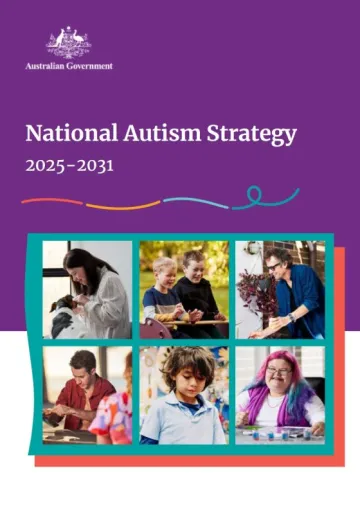
National Autism Strategy 2025–2031
National Autism Strategy First Action Plan
The Strategy is supported by the National Autism Strategy First Action Plan 2025–26 (the Action Plan). The Action Plan builds on what we heard through the national consultation process and the work of the National Autism Strategy Oversight Council and supporting Working Groups. This information will also be drawn on over the coming years as further actions are identified and implemented.
The Action Plan includes details of tangible actions that will support achieving the key outcomes in the Strategy.
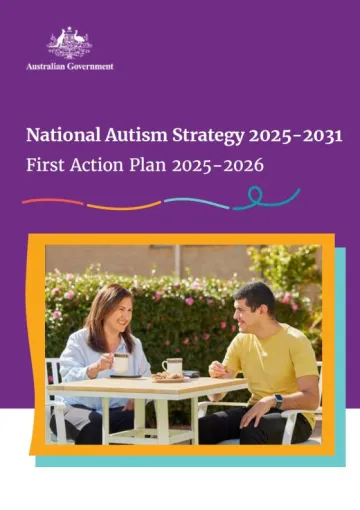
National Autism Strategy – First Action Plan 2025–2026
National Autism Strategy and First Action Plan implementation update
The National Autism Strategy Reference Group has been established and their first meeting was held on 23 February 2026.
The Department of Health, Disability and Ageing has commenced work on 81 per cent of actions in the Action Plan, including 7 policy/program reviews which included approximately 1,040 community engagement participations across 314 activities, and over 145 organisations have been engaged.
An infographic highlighting key Strategy and Action Plan implementation activity to date.
Autistic people share their stories
National Autism Strategy Reference Group
The National Autism Strategy Reference Group is advising government on implementation of the Strategy and the Action Plan, and will also help guide evaluation of the Strategy’s progress and impact to date. The Reference Group is co-chaired by Mr Chris Varney, a passionate lived-experience advocate, and Mr Ross Schafer from the Department of Health, Disability and Ageing.
National Autism Strategy Oversight Council
The development of the Strategy was informed by an expert National Autism Strategy Oversight Council that provided advice to Government. The council was co-chaired by Mrs Clare Gibellini – Autistic and autism community member and Mr Luke Mansfield – Department of Social Services.
How to talk about autism
We acknowledge that people use different words to talk about autism, and that each person will have a way of talking about autism and themselves that they prefer. Some people in the Autistic community like to say ‘Autistic person’ (identity first language), some like to say ‘person with autism’ (person first language), and some are fine with using either.
We use identity first language to talk about the National Autism Strategy. This means we will be using the terms Autistic person or Autistic people.
Sign up for updates on the development of the National Autism Strategy and First Action Plan.
Archived Information about the Strategy
Find archived information about the National Autism Strategy on the National Library of Australia's web archive.
News

Release of the National Autism Strategy 2025–31
Resources
National Autism Strategy resources
Autistic people share their stories
