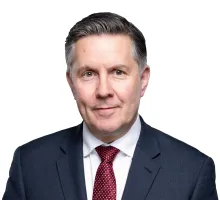
ANDREW CLENNELL, HOST: Alright, joining me live now is the Health and Aged Care Minister Mark Butler. Mark Butler thanks so much for your time.
MARK BUTLER, MINISTER FOR HEALTH AND AGEING, MINISTER FOR DISABILITY AND THE NDIS: Morning, Andrew.
CLENNELL: I'm going to start with you on this Luke Gosling matter. He has been criminally charged with assault. Why will the Prime Minister not stand him aside as Special Envoy for Veterans Affairs in Northern Australia?
BUTLER: It's important to remember what the job of Special Envoy is - it's not a minister, not a ministerial position. It doesn't have any executive authority, any ability to make decisions that impact Australians. Of course, as you know, if he were a minister, he would be required to stand aside. But the special envoy is a very different position. It doesn't have extra salary, as I said. It doesn't have executive authority.
CLENNELL: What is the point of it?
BUTLER: It does play a role in advocating government policy in a range of defence and veterans' affairs, particularly drawing on his very significant experience serving in the ADF including as a peacekeeper.
CLENNELL: Ok, Mr Butler, I'm sorry, I think you've sort of got the hospital pass because we just happen to be doing this interview this day and you're the minister on, but I sort of can't believe this. If you're saying if he's a minister, and he would have to stand aside. Why on earth, as a special envoy, when you say he is conducting tasks for government around defence etc, wouldn't he have to stand aside? He's been accused of hip and shouldering. The Administrator of the Northern Territory.
BUTLER: But he's not a member of the executive. The system is very clear. As a member of parliament, you're not required to stand down as a member of parliament if you're charged. Obviously, there are some provisions around conviction, but he is really just a backbench member of parliament. He is not a member of the executive and that is a fundamental distinction in the separation of powers, as you understand, Andrew. Of course, if he were a member of the executive with decision-making power, with authority vested in him by the Governor-General, that would be a very different matter. But he is not. And he's going to defend these charges strenuously, as I understand.
CLENNELL: Well, why do we have these special envoy positions? Is it so they can put a little badge on? Is it a little PR exercise? Or do they actually have any role in the government. They have a role, do they not?
BUTLER: They don't have an executive role, and that's the important distinction. They have a role, like every member of government on the backbench has a role. Their role is a little bit more focused, whether it's in the arts or, in Luke's case, in the area of defence, but it is a non-executive role, and that's the important distinction, Andrew. You've got to remember here our system, not our political system, but our legal system is very much founded on the presumption of innocence. But there is an exception to that where you have executive authority in the government, you would be expected to stand aside. But for everyone else, whether you're a member of the community or a backbencher, including Luke, you're entitled to the presumption of innocence. He's going to fight these charges strongly and we'll see how the court process unfolds.
CLENNELL: You saw some footage there I played at the start of the show. You're standing with Anthony.
BUTLER: No, I didn't. Sorry.
CLENNELL: Okay, well, you can look at it now. Look, seven years ago you're standing there with Anthony Albanese while he demands that former Prime Minister Scott Morrison aside Angus Taylor as a minister while there was a police investigation into him. He wasn't charged. It was a preliminary investigation. Do you accept that the stance of the Prime Minister and your government on this matter, given your previous calls for so many people to stand aside when they're not even charged is hypocritical.
BUTLER: I go back to my earlier point, Andrew, that there is something qualitatively different about serving as a member of the executive, serving as a minister. And if there is anything that, as a matter of perception or substance, is going to impact on your ability to conduct yourself as a sworn member of the executive, as a minister or an assistant minister, then the precautionary approach is to stand aside during whatever that process is, whether it's an investigation or a criminal charge. I do stand by what we said at that time several years ago because I took the view then and I take it at the very least on the perception of Angus Taylor's ability to do that ministerial job back then. But the important distinction, Andrew, is he was a Minister of the Crown. Luke is not.
CLENNELL: Can we really have special envoys going around hip and shouldering people and elbowing them in the guts?
BUTLER: That is a matter before the courts and neither of us should be speculating about what happened there.
CLENNELL: Alright, well let's talk about this at least. What do you make of Mr Gosling not fronting up to police when they called him for an interview? Surely someone on your team should be cooperating with police?
BUTLER: I haven't followed every precise detail about this, but I understand there is a contest about what happened here. Luke has publicly put an account about what happened over the days leading into Thursday morning when he was arrested by police. And Luke stands by that position. I'm not in a position to say who is right or wrong about that. But again, I don't think it's appropriate for me to try and get in the middle of a set of facts that are contested, ultimately, they're going to be determined by a court of law.
CLENNELL: Mr Butler, when you guys got in, in 2022. You're all about standards. You set up a knack. You had already called for all these ministers to go. You were going to be different. I put it to you that the Prime Minister's handling of this matter means you are no different to any other government. You guys just don't want to give a scalp. What do you say to that?
BUTLER: Ultimately, this is a matter for the courts to determine, Andrew, not you, or me, or the Prime Minister. Once a matter is put before the courts, to use your language of a scalp, is a matter before a judge, before the judiciary, not before the media, not before the executive, a Prime Minister or a Minister.
CLENNELL: If he's guilty, should he go from the Labor Party and or the Parliament?
BUTLER: I'm not going to speculate about that, Andrew. Again, there are provisions about convictions. They're very clear. They're set out in black and white. Of course, they would be enforced. That would be done by any government. But, of course, I'm not going to speculate about what an outcome through a court process that is completely independent of government is going to be.
CLENNELL: Let's talk about this health rebate change that you're seeking to make and get through the parliament. It means less of a rebate for the over 65s, What's your message today to over 65s about why they are going to be charged more from April 1 for their health insurance?
BUTLER: My message, first of all, is we are doing everything humanly possible to build an aged care system that gives you a confidence that you're going to be cared for with the dignity that you deserve after a lifetime of contributing to this country, building this extraordinary country we live in. But I also send a broader message that with a portfolio that I have the privilege of steering that is under constant cost pressure. We are always having to find ways to fund new services. Every dollar that is raised through this change to the private health insurance rebate is being reinvested into more beds, into more packages, and a better aged care for older Australians. I would love not to have to make some of these difficult savings decisions that I have made over the course of the last four years in government. They're never popular, but they are part of what I see as a responsibility to manage the budget well and to deal with some of these cost pressures that come onto us every single budget.
CLENNELL: The suggestion that the government's put forward on this is it will cost seniors sort of an average of $250 extra each a year. Are you doing this partly or do you feel you're politically able to do this partly because these people over 65, they're more inclined to vote for your opponents than for Labor?
BUTLER: No, that's not a factor, even if you're right about that, Andrew. I'm not sure you are, but that's not a factor. I think what it does is to restore the position of the private health insurance rebate to its original design, which is that people would receive a rebate pretty equitably across the population, rather than different levels of support according to age. As you know, John Howard introduced a new arrangement when frankly the budget was in a very different position, lots of money coming through the China boom, the baby boomer still in the workforce, certainly not drawing on aged care. And so he was able, in the shadow of the 2004 election, give a bit extra to older Australians to pay for their private health insurance. So you ended up with a position where two households living next to each other on exactly the same income would be receiving different levels of support for their private health insurance bill. One, for example, in their 40s or 50s with kids and another over 65. And we take the view that although this is a difficult decision, which I understand is unpopular, it is in policy terms pretty hard to argue with that people should receive the same level of support for their private health insurance according to their income, rather than according to their age. And still, say, people on $50,000 or $60,000 a year, will get about a quarter of their private health insurance bill paid for by taxpayers.
CLENNELL: Do you expect to get this change through the Senate with the support of the Greens?
BUTLER: Well, I'm not sure yet, frankly, Andrew. There's a Senate inquiry going on. The Greens have put different views about this in the public realm, but broadly said they want to see the result of the Senate inquiry, and that's fair enough. It's still got some weeks to run. The Greens have a very different policy to ours on private health insurance. They say that the rebate should be scrapped entirely for everyone. That's currently a rebate that costs the government about $8 or $9 billion a year. It's a very important part, I think, of our world beating mixed health system, a mix of public services and a private system supported by taxpayers. So we have a very different view to the Greens. Whether they'll support this more modest measure, I don't know. The Liberal Party seems to be indicating it won't, but it hasn't said, for example, how it would intend to fund that $3 billion of expanded aged care services that I talked about, or would they simply scrap those services? So it's a bit of a mixed picture here. There's an inquiry underway, which is fair enough, and we'll probably get a clear review later in the year when the inquiry's finished and the bill comes before the Senate.
CLENNELL: What about these concerns from the states that this private health insurance rebate change would lead to more elderly coming off the private health insurance system and lead to more cost shifting to public hospitals. Have you done any modelling on the possible effect of that?
BUTLER: I saw some reports about that late last week from a few of the state governments, and they were essentially parroting the modelling that the insurance industry has been putting about. Ours is very different, as you'd expect. The insurance industry talks its own book, and that's sort of part of the nature of things. Our independent modelling done by our officials suggests that maybe at most 44,000 people out of several million would drop off private health insurance because of this measure. That's a very small percentage, not even 1 per cent, half a percentage point at a time when insurance is growing. And obviously, most of them wouldn't be using the public hospital system anyway. So I'm not quite sure why the health ministers were out parroting that insurance industry modelling. It's very different to ours. I don't understand state governments have done their own modelling. We're very confident that this is the right thing to do, including by way of the public hospital system?
CLENNELL: Today the fuel excise cut comes off or at midnight. I don't want to send everyone watching straight to the bowser, but what are you expecting the reaction to that to be what sort of effect do you think it'll have on inflation?
BUTLER: When it was taken off the excise, that had a good impact on inflation and that will equalise when it goes back to situation normal, as it will over the course of the next several hours. Half of the excise was returned, as you know, a month ago. It will have an impact at the bowser. We've been honest about that shouldn't happen immediately. When the excise was returned or half of the excise was returned a month ago, you saw the price creep up over several days, and I would expect the same to happen here, given that the excise is not levied at the bowser it's levied before the petrol goes into the tanks under the service station. But you've seen the fuel price jump around a lot already, haven't you, Andrew? Over the last two weeks, we've seen the petrol price increase by about 30 cents, not because of any decision government has taken, but because of the turmoil in the Middle East, particularly, again, around the Strait of Hormuz, but also more recently, in the Red Sea as well. So it just goes to reaffirm that we're all paying the price for this war, which can't end soon enough, not just for Australia but for the global economy more broadly.
CLENNELL: Was there any consideration in government to, and I don't want you to name the forums, but you might have an idea, to extending this at all? Was there any consideration given or was it pre-blanket, nah, this is too expensive, we have to take this off?
BUTLER: Look, it is very expensive. We've just talked about some of the other huge spending pressures on the budget. So didn't take this decision lightly when we first made it back in March, but we thought it was really important to provide households and businesses with that cost of living relief, that budget relief. And when we got to the end of June, we also thought it was important to sort of ease the return to situation normal. But as the Prime Minister and Treasurer indicated over the last several weeks. We were watching this closely. We just think we've got to get back to a situation normal at some point and we've decided to continue with our original plan to do that this weekend.
CLENNELL: There's speculation or what Donald Trump has said he'll hit Iran pretty hard again this week. Iran are doing their own attacks. What's your reaction to all that?
BUTLER: I think it's the reaction not just of all members of government, but all Australians. We just want to see this conflict end. We want to see negotiations resume. There's some indication that they're happening in the background, but resume in a way that brings this conflict to an end, a ceasefire, an opening of the Strait of Hormuz, certainly for traffic to be able to continue through the Red Sea unimpeded as the Houthis have got into the conflict again as well. This is having a huge impact, obviously, on humanity in the region and the death toll and the massive dislocation we've seen in the region, but it's reverberating right through the global economy, hitting households here in Australia and hitting businesses as well. So our government's been very firm for months now. This conflict needs to end and the parties need to get back to the negotiating table and finalise an agreement to do that.
CLENNELL: Alright, so you've chosen the day the excise comes off to have some, the announcement of new medicine listings on the PBS. Can you tell us what you're announcing today?
BUTLER: This morning I'll be going down the road to the Royal Adelaide Hospital and announcing a really exciting new treatment for a very rare form of glioma or brain cancer caused by a particular genetic mutation. I mean, tragically, this hits people in very young adulthood, usually in their 20s, and 30s and is deeply, deeply debilitating. And we haven't had a new treatment for this particular form of brain cancer for more than 20 years on the PBS And we'll be adding it to the PBS this weekend. About 130 patients are going to benefit from that. And extraordinarily, they would otherwise have been paying $28,000 a month for treatment, obviously well beyond the means of almost all Australians. Now it will be available at PBS prices. And that's just one of the medicines we're adding to the PBS this month, Andrew. There are other for thyroid cancer, for blood cancer. And really importantly, as well, hundreds of children who are impacted by a difficult bowel disease, Chron’s disease as well. So it's a great illustration of the magic of the PBS bringing the world's best medicine at affordable PBS prices.
CLENNELL: Swimming legend Dawn Fraser has had a crack at the PM in the papers this morning for not condemning the ABC over this offensive race around the world skit involving Gina Rinehart What do you make of that?
BUTLER: I haven't seen the skit, but I have read reports of it and I guess the particular passage in it that people are offended by- and it's pretty revolting and it's not the sort of thing I think we should see on TV, whether it's News24, a commercial television show, or our public broadcaster, frankly. I understand the ombudsman within the ABC is investigating it, and that's appropriate at an independent public broadcaster. But, why do we have to see rubbish like this on our TVs, regardless of who it's about. So I haven't seen Dawn Fraser's comments particularly, but I have seen coverage of this episode. I understand the person responsible for it has apologised. But, at the end of the day, this sort of material shouldn't be on our TVs, I don't think.
CLENNELL: Hard to disagree. Now, look, a lot of speculation last week when we were at Labor conference there, Mr Butler, that South Australian Premier Peter Malinauskas could be drafted to Canberra and be a future Labor leader. Now, would you support him going to Canberra, particularly when people talk about you in connection with the job?
BUTLER: What I do know is I strongly supported Peter in the last state election, and he is doing just an extraordinary job as South Australian Premier. I was in his electorate as a constituent of his for a while. The boundaries have shifted, so I'm not right now. Look, all of this speculation really is just that. It's just speculation. I think Peter is really one of our outstanding politicians, not just here in South Australia but right across the country. His talent, his vision, has also garnered international attention. He's shown rural leadership in areas well beyond his job as South Australian Premier I think he's got absolutely enormous, almost limitless ability and he's still a pretty young bloke as well. I'd love to see him continue to do his job as South Australian Premier but what that means beyond that is really a matter for Peter and not a matter for me to comment upon. But what I will say is that all of us, whether of the Federal Cabinet or Labor Premiers like Peter, I know, are very, very keen to continue working under the Prime Ministership of Anthony Albanese. You and I have talked about that before, Andrew, I feel it's an enormous privilege for me to be able to continue in this portfolio, serving the interests of Australians in health and disability and ageing and serving under a Prime Minister for whom I have the greatest respect.
CLENNELL: Mark Butler, thanks so much for your time.
BUTLER: Thanks, Andrew.
Media event date:
Date published:
Media type:
Transcript
Audience:
General public
Minister: