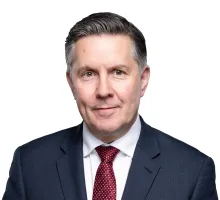
MELISSA CLARKE: The federal government is heading into the summer break after striking a flurry of deals with the Greens, including carving pensioners and part pensioners out of its private health insurance rebate changes. For more, I want to bring in the Minister for Health and Ageing, Mark Butler. Welcome to Afternoon Briefing. Thanks for joining me this afternoon.
MARK BUTLER, MINISTER FOR HEALTH AND AGEING, MINISTER FOR DISABILITY AND THE NDIS: My pleasure, Melissa.
CLARKE: So, have you found the Greens constructive to work with on policy in the last couple of weeks?
BUTLER: I've only really been dealing with this particular issue around private health insurance. We had two pathways, as we tend to do in the Senate, to get this responsible saving through that was directed at freeing up some money for more aged care investment. The Coalition, that talks about fiscal savings in the abstract but so rarely supports us in the specifics, said they weren't interested. So we did end up engaging with the Greens and we were able to agree an amendment.
CLARKE: The deal that you made, though, is going to make a big difference to how much you'll actually save. This was meant to be a savings measure. You're only going to save about half as much. Are you going to have to find that difference from your portfolio?
BUTLER: We'll have to reconcile that in a future budget update, of course.
CLARKE: The one in a couple of weeks' time?
BUTLER: No. There's no time to do that - we're about to put the mid-year budget to bed. But at some point, we’ll have to reconcile that.
CLARKE: So the mid-year budget update is done? The changes can't be made at this point?
BUTLER: There's still work to do, as Jim Chalmers said. But this is a big change that we've just seen passed through the Senate. But of course, we'll update. There are big changes in my portfolio that involve a lot of expenditure all of the time - there's constant reconciliation happening. Remember, this is a Budget 2026 measure that saw $60 billion of savings booked by the treasurer - more than 50 billion of those were from my portfolio. BWe've lost about one and a half billion of those, but that’s out of more than $50 billion my portfolio contributed.
CLARKE: I do want to come back to that, but I'm just a bit confused. Because the treasurer is saying that decisions are still being made, that's why he doesn't want to make any announcements, get ahead of what the ERC is still deciding. But you're saying you can't account for a one and a half billion dollar difference at this point of the process?
BUTLER: It will likely appear at some form, but whether we can reconcile that and find a way to square the books really in a matter of days is unlikely. But of course, these things happen in my portfolio all of the time between budget updates. And in the following budget update, which will be next May, we'll have to have reconciled that.
CLARKE: Did you underestimate the cost of living pain that older Australians are feeling when you announced- first announced this right near the start of the year, before the budget time? Did you underestimate how much difficulty it might cause for older Australians?
BUTLER: I was always eyes wide open that this was a difficult measure to take, and one that I would prefer not to have done. But over the budgets that I've been responsible for in this portfolio, we've seen aged care expenditure go from $24 billion when I first took this job, to $44 billion. At some point we do need to look at savings within our portfolio to fund that extra investment that I think everyone agrees is absolutely vital right now.
CLARKE: Now, you mentioned before that there's already been a lot of savings made in your portfolio area. We've seen big changes around aged care, NDIS, obviously we've got health and hospital agreements as well. So, does that mean that your portfolio gets a pass in looking for savings in this mid-year budget update, or are there going to be more cuts in your portfolio area?
BUTLER: I'm not going to reveal what we might be doing in the mid-year budget update. But my portfolio is always front and centre because we are the biggest spender in the government by a long way. If you add up health and hospitals and disability and aged care, we're a big spender. Pretty much every area is dealing with significant growth in demand.
CLARKE: But as you say, there's already been $50 billion worth of savings made in your portfolio area. The course of that has caused a lot of distress to many people, particularly in the disability community, about the impact of some of those cuts. There's no reassurance for them that there isn't more coming?
BUTLER: I’m not going to rule in or rule out what happens in the mid-year budget review - that won't surprise you, Melissa. There's only a couple of weeks to wait.
CLARKE: I'm a bit impatient.
BUTLER: You are impatient. It's in the nature of your job, though.
CLARKE: It is in the nature of my job. But I also know how much the cuts that have already been in place have affected the disability and aged care community, in particular, and that means a couple more weeks of stress for many families worried that there might be more cuts coming.
BUTLER: Well look, this is in the nature of budgets. You can't adopt a rule in or rule out approach to this. The treasurer has made pretty clear our approach to this. We are going to have to find responsible savings to match any expenditure that comes out of the mid-year budget review. We're not going to do a slash and burn approach - that's not in our nature. We're really conscious of the pressure that households are under, whether they're younger households, working families, or older Australians as well.
CLARKE: Have other ministers done enough to find savings in their portfolio areas?
BUTLER: I have the privilege of sitting on the Budget Committee, the ERC. I see every minister from our government come in and present really solid proposals for, obviously, new investment. There's much we want to do as a progressive government, a Labor Government, but also recognising the need to make responsible savings. That doesn't mean there won't be responsible cost of living relief when we can. I mean we, just this morning, passed the Cheaper Medicines legislation that locks in the $25 ceiling on PBS scripts for general patients for the rest of the decade. That's a modest proposal, but it will make a difference not just to people's budgets, but also to their health.
CLARKE: The government's managed to secure passage through the Senate for a number of bills as we've hit the end of the year - that's good news from Labor's perspective. But you are heading into very difficult economic times - 2026 is- and 2027 is looking a bit grim for a lot of households. What's the view of the government of what households should be bracing for next year?
BUTLER: The Treasurer, laid that out in very clear terms earlier this week. I can't remember a time when a budget or a budget update was, essentially, previewed with as full a statement of our economic circumstances as the one that Jim delivered on Monday, and it was honest. He was really honest for the Australian people that things could well get tougher than they are even now because of the nature of pressures in the global economy. We recognise there are pressures in our own economy as well but, really, what we've seen over the last 12 months since the war in Iran began, right across the world it's additional pressure.
CLARKE: We're seeing political ramifications from this pain as well. There's a lot of frustration with the government. That is part of what is fuelling the rise of One Nation. We've seen today, a defection of Liberal Senator Leah Blyth from the Liberal Party to One Nation. Is One Nation's strength growing in your state of South Australia?
BUTLER: They had a relatively good result in the South Australian election against a strong Labor Government led by a very capable, very popular Premier. They almost exceeded the number of seats the Liberal Party won at the state election there earlier this year. So, there's no doubt that they are recording votes that we've never seen before. This defection, though, from Senator Blyth to One Nation is pretty extraordinary. The way in which she has expressed her lack of trust in a Liberal Party of which she was state president very recently and she was appointed a front bencher only nine months ago, sort of raises questions about why the Australian people would trust Angus Taylor if she can't.
CLARKE: I mean, defections happen quite a bit. The Labor Party has been the recipient of two defectors as well. You can't really throw too much shade at Senator Blyth here, can you, when you've accepted Tammy Tyrrell and Dorinda Cox coming over to your side?
BUTLER: I'm not really trying to cast any shade at Senator Blyth. She has made a decision based on her lack of trust in the Liberal Party. She's made a decision based, I think quite extraordinarily and pretty concerningly, about the fact she didn't feel physically safe in a formal Liberal Party forum. She's made that clear. She's told the story of having to hire private security. And yet still I'm not aware of anyone with authority in the Liberal Party, including Angus Taylor, who has taken any action about the extraordinary statement by a senior woman, a former president, a serving frontbencher, to say she did not feel physically safe at a Liberal Party state council forum.
CLARKE: Mark Butler, are you expecting to stay in the health portfolio right up to the next election?
BUTLER: Yes. Ultimately that's a matter for the Prime Minister, but he's not given me any indication he's intending to move me. I love this portfolio. I was in it under the last government. I've been in it since Anthony won the 2022 election. It's a great privilege that I thoroughly enjoy.
CLARKE: Wouldn't thoroughly enjoy the privilege of a more senior portfolio?
BUTLER: There is no other portfolio I would like to undertake. I absolutely love the work in health and disability and in ageing. They're areas I've worked in for a very long period of time. I meet the most extraordinary Australians.
CLARKE: You would also be very conscious of the desire for some generational change in Labor. It has a very large Caucus right now. You yourself have noticed and noted the talent that sits within the party. How should the Prime Minister go about recognising and advancing that talent?
BUTLER: That's a matter for him. He leads this party with extraordinary authority, but also extraordinary respect. And I think people have great confidence in his ability to marshal the team around him in the way that's going to be most effective for the government, but much more importantly most effective for the country.
CLARKE: All right. Well, we'll see. Mark Butler, thank you very much for joining me on Afternoon Briefing.
BUTLER: Thanks, Melissa.
CLARKE: And that is Mark Butler, the Health Minister and Minister for Ageing. He was talking about the private health insurance rebate, and we also got to talking a little bit about politics in South Australia.
Media event date:
Date published:
Media type:
Transcript
Audience:
General public
Minister: