
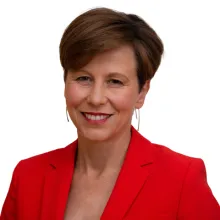
ANDREW CLENNELL: Joining me live is the Minister for the NDIS, Jenny McAllister. Thanks for joining me.
JENNY MCALLISTER: Thanks for having me.
ANDREW CLENNELL: Thanks for joining us. The opposition is threatening to hold up your NDIS reforms if you don't separate out your tax bills to have the $250 payment away from the capital gains tax changes. What's the consequence of a hold up to the NDIS reforms?
JENNY MCALLISTER: Look, we made it really clear that we think the NDIS is a life-changing reform, but we also want it to be sustainable for the long term. We are principally reforming the scheme, so it will be here when people need it in a decade's time. Right now, it just costs too much, but the changes we propose do involve savings to the budget, and the consequences of delay are significant. Now, the coalition talk a lot about the need to restrain costs. If they're serious about that, we hope that they'll engage with us and get this bill through. I will say, to be fair to them, that they are engaging closely, constructively. My expectation is that we'll continue to have very constructive engagements with Melissa McIntosh, in particular.
ANDREW CLENNELL: How concerned are you the opposition might block the bills, because the Greens aren't going to pass them?
JENNY MCALLISTER: Look, I mean, I think there's always a lot of back and forth when it comes to bills coming out toward the Senate, but as I say, we are engaging really closely, really constructively with Melissa McIntosh. I think Australians broadly agree that this scheme needs to be reformed, and I think it's in the national interest that the coalition engage with that proposition seriously.
ANDREW CLENNELL: Why does the government not make the $250 working Australian tax offset a separate bill to the capital gains tax changes?
JENNY MCALLISTER: Look, these changes are traveling together for good reason. We are bringing an ambitious package of reform through in this budget. We're seeking to essentially reset the tax arrangements to provide fairer treatment between the way that we treat income from assets and income from labour, and also critically to make sure that first homeowners have a better chance when they turn up to an auction. It's all part of essentially resetting the tax arrangements, so we deal with questions of intergenerational equity and sustainability,
ANDREW CLENNELL: It's a wedge, isn't it?
JENNY MCALLISTER: We are bringing these forward for good policy reasons, which is that it's a tax package, which seeks to reshape the tax system to make it fairer and sustainable for the long term.
ANDREW CLENNELL: If you can get the NDIS savings through, why not just separate those other bills, the capital gains bills from the WATO,
JENNY MCALLISTER: Well, in the first instance, Andrew, we think the NDIS proposals stand on their own merits. We do think the NDIS needs to be sustainable, so do the Australian people. We've done a detail, put a detail package together, which we think will deliver that, and we are hopeful that the coalition will support that, because it is the right thing to do.
ANDREW CLENNELL: You just want to be able to say Angus Taylor's opposing tax cuts again, don't you?
JENNY MCALLISTER: Well, the coalition needs to make a decision about how they approach questions of tax and reform generally. In the last few months, they've essentially created half a trillion dollars of unfunded promises that would blow a hole in the budget, they need to explain what their approach to budget sustainability is.
ANDREW CLENNELL: What about this argument that's been made that you've spent the NDIS savings already on things like extra hospital funding to get the deal with the states, plus Thriving Kids funding?
JENNY MCALLISTER: Look, every budget we look for savings reprioritisations to allow us to make room for the priorities that the Australian people expect us to fund. People expect us to find money for hospitals, people expect us to find money for supports for people who are not on the NDIS, but the reason we are bringing forward the changes to the NDIS is principally to make sure that this scheme, which is so important for the human rights of people with disability, will be here in a decade's time and will retain public support.
ANDREW CLENNELL: Did Jenny Wilkinson, the Treasury Secretary, effectively bell the cat on this when she said during the week the government had to get revenue from somewhere, and that these tax changes are primarily about revenue?
JENNY MCALLISTER: The tax changes are reforms that seek to put the interests of people who want to buy their own home and to get started in their working lives right at front of mind for government. The principles that came out of the economic reform round table were really around making sure that the tax system is intergenerationally fair, that it enhances and drives productivity, and that it's sustainable. I don't really think anything Ms. Wilkinson said is at odds with that. We've been really clear that we need a sustainable tax system, a sustainable budget. I think the big question for the opposition as they engage with this, is are they their objectives? They've put forward a whole range of changes that blow a half trillion dollar hole in the budget over the next..
ANDREW CLENNELL: How do you come to the half trillion?
JENNY MCALLISTER: Well, when you look at the changes that they've made around indexation, when you add in their proposal of defense spending, when you add in their proposals around rolling back some of the other changes around super, you get to a very big number very quickly, and Angus Taylor has not explained how he will pay for those expenditure items that he has outlined.
ANDREW CLENNELL: Can you just add up the half tree in for me? So, how much is the tax cuts, how much is the defense spend?
JENNY MCALLISTER: Andrew I do not have each of those in front of me
ANDREW CLENNELL: You've come out this morning with this half a trillion figure, but you can't actually give me how you arrive at the half trillion.
JENNY MCALLISTER: Yeah, well, they're outlined in the materials that have been made public by the treasurer.
ANDREW CLENNELL: All right, you've announced some changes aimed at cracking down on fraud. What can we expect out of that?
JENNY MCALLISTER: Look, the NDIS was ignored by the Coalition for too long, and it really left it a soft target for shonks and grifters, and we have to deal with that. In our first term, make big investments in an enforcement capability, but in the bill that's before the Parliament at the moment, we've got new powers for the NDIA, they'll be able to obtain warrants, they'll be able to require people to produce documents, they'll be able to require people to maintain records, and we'll also require highest risk providers to get registered, and every provider to enroll with the NDIA so we can see where the money is going. It's all about being able to create a much higher level of accountability, because we are seeing too much sharp practice in this system, and it's dangerous for participants.
ANDREW CLENNELL: What percentage of the savings in the NDIS will be from this sort of fraud crackdown?
JENNY MCALLISTER: Interesting thing about fraud is that, and non-compliant claiming is that generally we don't see significant savings to government. For the most part when we interrupt a person who is taking money away from a disabled person, what then happens is that money is returned to the person with disability for its proper use. So, it's generally not about budget savings, it's about making sure the scheme operates with integrity, so that it can support people with disability.
ANDREW CLENNELL: Do you believe we'll see people jailed under these changes?
JENNY MCALLISTER: We are already seeing people sent to jail, so I'm aware of at least four occasions this year when a custodial sentence has been imposed on a person who defrauded a person with disability, and I really do have a very clear message. If you think, as a provider, that it's okay to take money from people with disability, you do not belong in the NDIS. You belong in jail.
ANDREW CLENNELL: These changes you've announced aim, by the end of the decade, to reduce those on the scheme from 760,000 to 600,000. Are you confident you're going to be able to achieve that? What's your message to the parents of kids who are going to get taken off the NDIS?
JENNY MCALLISTER: Look, this game was always intended to be for people with permanent and significant disability. It was never intended to apply for all Australians with disability. In fact, there's three and a half million Australians under the age of 65 with disability, and by no means are all of those people on the scheme at the moment. There were never any sufficient boundaries placed around the access arrangements for the scheme, and we do think we can reform it, but it doesn't mean that people don't need supports, and one of the things we're doing with the states and territories is building up the supports that exist outside the scheme, so that the NDIS isn't the only place that people can turn to if they need help.
ANDREW CLENNELL: Now, you've copped a fair bit of flack for the capital gains tax and negative gearing changes. On capital gains tax, are you, is there any part of you concern these changes could actually stymie investment?
JENNY MCALLISTER: Look, this is a budget that is very focused on enhancing productivity and investment. In fact, we think that over the long term, having a more equal treatment of investments of income earned from assets or labour is a fairer basis on which to run the tax system, and one that will be more sustainable over the long term too. But of course we want to see people continuing to invest, and the budget contains about three and a half billion in arrangements to support small business investment and to support business investment generally.
ANDREW CLENNELL: How big are the carve-outs likely to be for start-ups and the like?
JENNY MCALLISTER: Look, I think the treasurer's made public comment about that. I saw his exchange with you earlier this week, Andrew. We are consulting with small business around the implementation arrangements, but I'm not going to get ahead of that. There are conversations being had by Treasury, and I gather by the Treasurer himself.
ANDREW CLENNELL: Are you confident the Greens will pass the negative gearing proposals through the Senate?
JENNY MCALLISTER: Look, those are questions for the Greens. I'm not involved in those conversations directly, but again, our government recognizes that young people, in particular despair at the challenges that face them getting into the housing market. We see rates of home ownership for that cohort, 25 to 29 just going like that. We have to do something about it. We think this is the right thing to do. I'd encourage all senators to contemplate their vote on this question. Young people can't afford for the status quo to remain in place.
ANDREW CLENNELL: There was an incident Thursday question time, if you'll excuse my language, where Angus Taylor's called Anthony Albanese an arrogant prick. What do you make of that?
JENNY MCALLISTER: Well, I don't think the Prime Minister's going to be overly worried about it. He's got a pretty thick skin. I think it's probably just an indication of Mr Taylor's frustrations, right? He'sin a situation where, you know, his coalition party is really leaving an incredible vacuum. He's seeing one nation come up, challenging them, winning the by-election in Farrer. It's really up to him to explain his own language, though, isn't it?
ANDREW CLENNELL: Well, finally, just speaking of that, I've got Pauline Hanson on next. How well do you think one nation can do with the next election, and what would it mean for Australian politics,
JENNY MCALLISTER: Yeah. Look, I think one nation is stepping into a void that has been created by the disunity and chaos that is present in the coalition. I mean, I don't think the Liberals and the Nats have ever been further apart. There is significant division within the Liberal Party, and you can see it every day in the Senate, when we're all there together. I think that a challenge for one nation will be to actually start to articulate some solutions. Right, there are a lot of grievances, a lot of complaints. It's not really clear what the solutions are that they are offering.
ANDREW CLENNELL: Jenny McAllister. Thanks so much for your time.
JENNY MCALLISTER: Thanks, Andrew.