
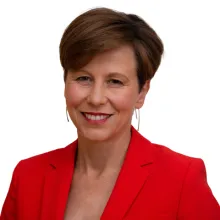
THOMAS ORITI: Thanks for joining us. Nine minutes past three on 702. Big changes to the NDIS today. The Federal Health Minister Mark Butler has announced a move to reduce the number of participants from 760,000 people today to about 600,000 by the end of the decade. So cutting the number of participants by about 160,000 people. The Government will also aim to reduce the total cost of social and community support from an average of $31,000 at the moment, $31,000 per person this year to about $26,000 within the next two years. There's also, crucially, going to be a crackdown on registration. So the Government will be expanding the categories of providers who will need to be fully registered to provide support under the NDIS. Senator Jenny McAllister is the Minister for the National Disability Insurance Scheme who's with us now, Minister, thanks for joining us.
JENNY MCALLISTER: Thank you for having me.
THOMAS ORITI: Your Government says we need to move away from the so called “let it rip market” that has built up over the past decade with the NDIS, to what extent has the scheme been allowed to let rip?
JENNY MCALLISTER: This is a really important social program, and your listeners, I think, will be rightly proud of this uniquely Australian intervention to support the human rights of people with disability. Choice and control was embedded at the heart of this scheme, and the idea was that people with disability would choose the supports that would work best for them. However, over the last decade, we have seen an influx of providers into the scheme, some of whom are not providing the level of quality in terms of the support that we would like to see for people with disability, and some of the reforms that we're announcing today are really about getting to the heart of that, making sure that when people go to market looking for a service to support them, they're working with a provider who's got the skills and the integrity and the capability to really provide the supports that disabled people deserve.
THOMAS ORITI: I must admit, one thing that really shocked me is this news that currently the NDIA has no visibility of evidence for 90% of claims made by plan managers or by providers directly. I've got to say, that seems extraordinary. Shouldn't every claim have some sort of visibility of evidence?
JENNY MCALLISTER: Yes is the short answer. This is a significant design flaw in the way the scheme was set up over the last decade, and we intend to deal with it through a number of means, but principally by working to improve the ICT system, so that, over time, we start to pay providers directly, rather than through intermediaries, and in the meantime, commissioning a small number of intermediaries with high quality skills who can provide those Plan Management Services and make sure that the Scheme remains on track.
THOMAS ORITI: I know there'll be a crackdown on registration. You know, expanding the categories of providers who need to be fully registered. But I wonder, why not go further? I mean, if any provider isn't registered, shouldn't there be a red flag? Shouldn't we be asking why?
JENNY MCALLISTER: We're going to proceed in two ways. The first is that almost every provider that provides services within the Scheme will need to enrol with the NDIA.
We'll have visibility on those people, those businesses, and we'll be able to make sure that money is flowing to where it does, where it needs to go, for people who offer their services that we judge as high risk, for example, helping people with personal care, helping people in a closed setting where there's limited visibility from others, we will require those services to register. And the important thing here that is where the large volumes of money are in the scheme, we estimate that 90% of the value of services provided in the Scheme will be delivered by registered providers once these arrangements are in place.
THOMAS ORITI: But in terms of reducing that eligibility and cutting down on participants. I mean, part of what the Minister announced today is that people on the scheme will be judged by their functional capacity and not their diagnosis. What does it actually mean?
JENNY MCALLISTER: This was a key recommendation of the Independent Review that was undertaken into the NDIS. In the past, people have been allowed to access the Scheme dependent on a diagnosis. Do you have autism? Do you have a vision impairment? Do you have mobility impairments? What the Review recommended is that we actually assess people, not on their diagnosis, but on how their disability affects them in daily life. Do you have a very high need for supports, or merely a modest need for supports? And that's the system that we seek to put in place. It was a key recommendation of the review, and what we'd like to do is work with a technical advisory group, but importantly, with the disability community, to build up this assessment process and implement it as the review suggested.
THOMAS ORITI: Does that, for example, include diverting adults with autism from the scheme, in addition to kids under the age of nine?
JENNY MCALLISTER: I think Minister Butler was really clear about this. Today we are not seeking to target particular kinds of disability. The distinction we seek to make is how significant are your support needs? The Scheme was always designed for people who had significant and permanent impairment. The point of developing a Functional Capacity Assessment, as was recommended to us, is to make sure that the Scheme continues to deliver for those people, while at the same time building supports for other people with disabilities, whose needs may not be as intense.
THOMAS ORITI: Mark Butler also said today that other parts of the Scheme have gotten out of control, and one part is the runaway budget, in his words, for social and community participation. But I want to ask you about that, because the average plan spend this year on community participation, $31,000 that's up from around $14,000 five years ago. But I've got to say five years ago, we were in the depths of Covid. Is it fair to use a rise in community participation to justify a cut in budget, considering nobody, well, barely anybody, was active in the community five years ago?
JENNY MCALLISTER: Look this is a very significant expense for the Scheme overall. We are spending about as much on these kinds of supports as we do on the entire Pharmaceutical Benefits Scheme. We don’t make these changes easily, but we do think that this is an area where Scheme costs have gone beyond what is reasonable and necessary.
THOMAS ORITI: It’s not quite a metric though to compare it to, you know, the height of Covid lockdowns,
JENNY MCALLISTER: I think that we are making the broader point that it is a very significant component of Scheme costs, and we do think, in part, that there's a better way to deliver this. Today, we talked about establishing the Inclusive Communities Fund. We know that there are plenty of organizations across the community, and I visit them. You know, they're running sports programs, they're running arts programs. They're creating inclusive environments where people with disability actually become involved in the community. We're keen to build up those kinds of capacities because, regrettably, they have actually been allowed to wither away. We prefer to see people with disability living their best lives, making friends, becoming involved in community activities, and we think that we can make some important investments to assist with that.
THOMAS ORITI: Minister, obviously, there's a lot of anxiety about this. And when people on the Scheme hear about changing eligibility requirements, some might say that sounds, you know, a lot like the dreaded independent assessments, which was scrapped in 2021. There was intense pressure there, and it was heavily criticized as a box ticking exercise at the time. Will we even get a sense, or see again, a sense of that box ticking exercise, considering how desperate the Government is to rein in spending.
JENNY MCALLISTER: Two things here, of course, change is challenging and can be scary. What would be more scary, would be a collapse in community trust in this Scheme, and the Government's every decision is focused on ensuring that we retain social license for this life changing piece of social infrastructure in Australia. In terms of the practical ways that we will proceed, this couldn't be further from the approach taken by the Liberals in the past, the Liberals did not have the benefit of a very widely consulted Independent Review led by very respected people. They did not have a plan to work in a collaborative way with the disability community to develop and roll out a tool of this kind, and importantly, they really didn't have a plan to engage respectfully and seriously across the Parliament to gain support for their proposed approach. We know this matters to people with disability, and we're determined to work on it in a way that respects the integrity and the origins of the scheme and also involves people with disability in the decision you're making.
THOMAS ORITI: Senator, we appreciate your time. Thank you very much.
JENNY MCALLISTER: Thanks, Thomas.