
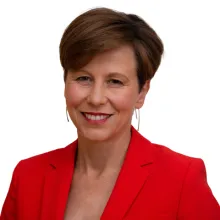
MICHAEL CLARKE: Jenny McAllister is the federal NDIS Minister, and is with us now. Minister, thanks for your time.
JENNY MCALLISTER: Thank you very much for having me on Michael
MICHAEL CLARKE: Seems like uncertainty is a key word that we were just hearing there from Dr Clements. How can you reassure people who may have that uncertainty, even a week on from this announcement?
JENNY MCALLISTER: I think that the thing that we must say to people who use this scheme is that we believe in it as a government, and we think that the Australian community believes in the scheme and is proud of it as well.
But I think everyone acknowledges that the scheme is presently not on track. There is way too much fraud. It costs too much compared to what was budgeted and forecast for the scheme, and that means it's distorting other parts of the care economy, like, for example, the veterans system. So we want to get this back on track to make sure that it is here for people with permanent and significant disability. You know, in a decade's time, there will be a little girl or a little boy who's born with a very significant disability. As a minister, I want to know that this scheme will be sustainable, that it will continue to have community support, and it will be there for that little girl or boy and their family in a decade's time.
MICHAEL CLARKE: But does that push aside all the families that have seen significant benefit from aspects of this scheme up till now, whether it be different programs or different support mechanisms that they've had up till now, will they be, are you basically telling them that that disability is not enough to qualify anymore?
JENNY MCALLISTER: The NDIS will continue to be the largest social program in Australia outside of the age pension. It will be the centrepiece of the most comprehensive suite of supports for people with a disability anywhere in the OECD. We are not walking away at all from the significance and importance of this scheme, but what we are saying is that it can't be the only form of support available for people with disability. It was always intended for people whose disabilities were significant and permanent and similar, and at the same time, it was always intended that for those people who were not eligible for the scheme, there'd be other supports available for them in the community. At the moment, there's more than 5 million Australians living with disability. 760,000 of them are on the scheme. That's still more than we ever anticipated. But we should acknowledge that not every person with a disability accesses the NDIS. And as a government and as a community, we need to make sure that the service systems are in place around the scheme, so that the NDIS isn't the only lifeboat in the ocean.
MICHAEL CLARKE: And are those systems in place already?
JENNY MCALLISTER: We are starting to rebuild them, Michael, and it's a key focus for our government. Earlier this year, we agreed with the states and territories that we put in place a new program called thriving kids. It's a $4 billion investment, with the cost shared between ourselves and the states. We want to put back in place those service systems that families used to access through maternal child health systems, through early learning areas, perhaps via their GP. These are systems that used to be in place for people with disability that have withered away. We don't think that's in the best interests of the community or in the best interests of people with disability.
MICHAEL CLARKE: So those are you basically asking other levels of government, the state government in particular, to come to the party here?
JENNY MCALLISTER: State governments have already agreed that this should be a priority. Two years ago, they agreed with us that we would spend $10 billion re-establishing these kinds of supports. Thriving kids is the first part of that. But there's more to do. There's another $6 billion that we can and should spend on building these service systems up.
MICHAEL CLARKE: But are we seeing that in Queensland at the moment, that agreement between the Federal and State Governments?
JENNY MCALLISTER: We continue to talk very closely to the Queensland Government. They, like every other state Premier, signed on to the agreement, which saw a very significant injection of funds, around 5 billion from memory, for Queensland hospitals, along with an agreement to co fund new disability supports. I think the people of Queensland want to see the Queensland Government working with us to set this service system up. We've had really positive reception from families about the prospect of having supports available in the community.
MICHAEL CLARKE: What about the timeline of delivering this information minister? Because if there was some uncertainty, or maybe we haven't had all agreements through, about what the other support mechanisms will be, should you have made that announcement last week?
JENNY MCALLISTER: We think it's really important to level with the Australian people about how we think about this scheme. It would be nice to say to people, there won't be any change, but that wouldn't be honest, and it's why Minister Butler made the speech that he did.
Setting out the scale of the challenge that the scheme was projected to grow to cost him $70 billion dollars a year by 2030, explaining that we didn't think that that was reasonable or sustainable, and setting out some of the steps we want to take to change it.
These things are going to have to be done in partnership with the disability community. Any changes to access won't start until 2028 that gives us time. Time to work with disabled people and take advice from experts about the criteria that we should apply in deciding who has access to the scheme. The guidelines for what permanent and significant disability requires haven't been really clearly established. Instead, we've relied on these access lists that are dependent on diagnosis. All of the advice to us from the independent review of the NDIS and elsewhere is that that access list system is distorting the kind of people who are accessing the scheme, and we just wanted to level with people, we don't think we can continue down this path, because the risk is that the community will lose confidence that the scheme is delivering as intended.
MICHAEL CLARKE: You're hearing this morning from the NDIS Minister Jenny McAllister, a week on from that announcement about those planned changes. You heard in the bit from Dr Michael Clements a mention of one body in particular, the AEIOU Foundation, which was a body that worked very closely with families with children who had severe autism in regional centers and providing the sort of care that they just weren't getting from anywhere else. A lot of those families now just don't know where to turn to. And we even heard from one mother yesterday on the program talking about her own grassroots support network she's putting together now to make sure that there is some support for her son. Does that concern you? And will we see more of these issues going forward?
JENNY MCALLISTER: So the NDIS provides funding to families, not to particular businesses or services, and so when a family receives a package, they can choose how to spend it. We're really aware of AEIOU’s decision to close their operations, and the NDIA, the agency that looks after the scheme, has been working really closely to assist impacted participants, to find help and information about services that they can find for their families.
MICHAEL CLARKE: Which is very hard in a regional centre like Townsville, isn't it Minister?
JENNY MCALLISTER: Look, we do see increasing numbers of service providers entering the NDIS market. It is always disruptive to a family when they change providers, but it does happen and when a provider closes or decides to stop offering a service, we work really closely with impacted families to help them get alternative supports.
MICHAEL CLARKE: I guess what families have been telling us, though is that the supports they were getting, particularly in this case, are not replicated anywhere else here in an area like Townsville, it's very hard to get that assistance.
JENNY MCALLISTER: We are working really closely with those families. I think one thing to be aware of is that we don't provide support for education services or childcare services or hospital services. The NDIS was never intended to substitute for those other service systems. We expect early childhood education, school systems, hospitals to be inclusive of people with disability, but the NDIS exists to provide families with those extra supports, and those supports continue for all of the affected families that you're talking about in Townsville.
MICHAEL CLARKE: And obviously a lot more information will filter out in time. How, how much information will we get in you know, the months ahead, as you say, as we move to this this change?
JENNY MCALLISTER: There are a range of different interventions that we're seeking to make to get the scheme back on track, and we'll continue to talk with the community about them, some of them, like the interventions we are taking to tackle fraud and get the poor performing providers out of the system will start to roll out from the first of July. Registration becomes mandatory for some kinds of providers on the first of July this year, and there's a second cohort of providers who will be brought into that system from the middle of 2027.
These are really significant interventions to clean up the scheme so that families can have confidence that the providers They're using qualified to offer services and will operate safely and with integrity.
Some of the other interventions that we seek to make, we want to co-design with people with disability, and we'll be talking with the disability community, with their key representatives, about exactly how we work together on those design questions.
MICHAEL CLARKE: And we will look forward to staying in touch with you as that moves forward. NDIS, Federal Minister, Jenny McAllister, we appreciate your time this morning.