
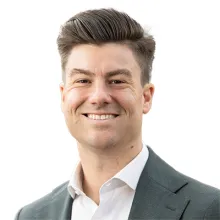
STEWART BRASH, HOST: Sam Rae is the Federal Minister for Aged Care and Seniors, and I spoke to him earlier about his trip to the centre.
[Excerpt]
SAM RAE, MINISTER FOR AGED CARE AND SENIORS: Yesterday was a busy day, talking to people from all across the community. We flew over those beautiful Macdonnell Ranges and went straight from the airport to Purple House to have a conversation with them about the amazing work that they're doing, supporting elders and older people all across Central Australia. Obviously, they do a lot of work in the dialysis space, but they also provide aged care services as well. So it was really great to catch up with them.
BRASH: It's interesting you mentioned that, Minister, because we've had one of our listeners this morning asking the question of you because we've asked for some questions from listeners. Do you have plans to build residential aged care facilities in larger remote communities instead of expanding aged care facilities here in Alice Springs? And I suppose there are already aged care programs out, but are there any plans to build aged care facilities so people actually can stay out bush?
RAE: Well, we are seeing the expansion of aged care operations across the remote communities in the Territory. We use a program called NATSIFACP, which is a bit of government speak, but essentially, it's a flexible aged care funding program for providers like Purple House, so that we can look at where there are remote communities that have older folks with needs and we can make the investments along the way that are required to meet those community needs. And we absolutely, where possible, want to keep people close to community, close to family, in culturally appropriate care settings. We're always looking at options to do that all across the Territory and Central Australia.
BRASH: And another one, Bob's just asked a question whether or not, Minister, you'll be heading out bush to see the provision of aged care in remote communities. Will you be taking that opportunity while you're here in the centre to do that?
RAE: Absolutely. Although it's always a busy fly-in, fly-out schedule that we have to do. I got here yesterday. I did spend most of the day in Alice, which was great because it's been probably a year since I've been to Alice, and I needed to catch up with people here locally. Today, I'm going to go and see some of the places to the south of Darwin and check out what's going on up there as well. But importantly, I do need to make sure that I get across the issues all across Central Australia. It's why catching up with people like the crew from Purple House is important because they've got such a huge reach, beyond even just the Territory – out into communities all across the different language groups, making sure that I understand what the needs are like across such a diverse population.
BRASH: So, are there any plans to build any more specialist aged care facilities in our remote communities?
RAE: Well, as I said, we're seeing ongoing development of such things. I don't want to pre-empt some of those decisions that need to be made along the way. But we've set up this flexible funding program so that we can capitalise on exactly those opportunities, Stewart. We want to listen to communities. We want to understand what they need, what they want, and how we can get the best outcomes for older people, and then use that flexible funding to deliver those projects.
BRASH: You're hearing from Sam Rae. He's the Federal Minister for Aged Care and Seniors. Now, I know you met with people yesterday. One of the key issues in Alice Springs is so many people – and I'm one of those people. I'm a transient person. I've only been here 30 years. A lot of people come to town, work their careers, and then talk about leaving town. I'm sure you had conversations yesterday about the creation of a seniors village for Alice Springs. What did you hear, and what can the Federal Government do to help?
RAE: I absolutely heard that from a range of different people across the community, Stewart. There's a few things that are happening around the place here in Alice. Of course, the Federal Government has invested in what's called a Specialist Dementia Care Unit. You might have heard about this. And the community has had some concerns, which they've raised directly with me, and certainly Marion has been advocating on their behalf as well. And this is around the original plan to repurpose Flynn Lodge. I've been to Flynn Lodge, I've been to Old Timers, I know these places, I've been to Hetti Perkins – so I know how important that they are to the community. I think the community's voice has been heard loudly and strongly here, and so there's been adjustments to that project. And so, the Specialist Dementia Care Unit is going to use some of the spare capacity at Old Timers to get up and running as soon as possible.
BRASH: Okay. So last time we spoke to ARRCS, they were saying they'd put the plan on ice because they wanted to move those 10 residents out of Flynn Lodge. You're saying an agreement has come that the dementia care unit will be built on a separate site at Old Timers, not involving Flynn Lodge?
RAE: It's going to use the Old Timers' facility as opposed to Flynn Lodge and get it up and running as soon as possible. Now, these are really important services. This is a program that we're rolling out across the country. We know, sadly, that dementia has become the leading cause of death in Australia. We've got about 450,000 Australians who are living with dementia, and they say that half or more of those cases would either be avoided entirely or at least be mitigated in terms of their impacts. These people with dementia-
BRASH: How much will be invested into the new site at Old Timers?
RAE: So the SDCU, the way that we do it is about setting up the clinical care program, and it's about making sure that we've got these specialist dementia care supports, including, for the first time, the geriatrician supports here in Alice that we need. People, particularly [those] who are getting stuck in that cycle in the hospital because they've got complex conditions, we can get them out of the hospital and into a more appropriate care setting. We're going to use the spare capacity at Old Timers in the interim to get that up and running as soon as possible.
BRASH: Okay. The money story, do we know how much that will cost?
RAE: Well, again, it's operational, right? It's about setting up the clinical care program. We fund capital costs, that's buildings and things like that, out of a separate fund called ACCAP, which we've spent about $175 million of ACCAP funding since 2022 here in the Territory. But we're always looking for these opportunities where we can make the necessary investments. We like to use some of the government investment alongside some of the providers making their contributions to get those really good outcomes that communities need.
BRASH: One of the issues also, and I know this is one of the challenges for aged care, is keeping people out of nursing homes. If you can keep people out of nursing homes, then the cost to government is reduced. Now, there’s no sort of retirement village setup here in Central Australia and Alice Springs where people can either have a secure place to live when they don't need to go to an aged care home. Did you have any conversations with any members of the public about that idea and how the Federal Government could help?
RAE: I absolutely did, Stewart. Listening carefully to people yesterday, our aged care system is tiered, if you like, from home care all the way through to that residential aged care. People were talking about the need for something in between there, something that is a sort of a supportive living arrangement, if you like. I know that there's been some discussions across the community and a proposal that's been bouncing around with some really good input going into it.
We had a further conversation about that yesterday as well, and where we got to was, well, first of all, the Federal Government doesn't fund retirement living. That's funded by private providers who do retirement living. We fund residential aged care because it has that care component built into it and attached to our health system. Nevertheless, they are obviously complementary. So, from my perspective, when we're talking about getting the best outcomes for older people, we look at all of these options and how we can support them. One option that might be considered along the way is that we have a sort of a co-use development, where we've got retirement living alongside residential aged care. So it's a really positive discussion about how to get more capacity, better outcomes and a bit of scalability as people move through their ageing journey.
BRASH: Would that be at a current facility? Because, of course, we have old timers in Hetti Perkins. Or would that be something completely separate?
RAE: Well, the project that I was being shown yesterday was a separate project, but I'm not closed-minded about this, Stewart. My focus is on getting the best outcomes. These projects can be quite lengthy. You think about building an entire facility. Sometimes this takes sort of five to seven years from conception through to the time that we actually start looking after people. If we can expedite that by leveraging existing infrastructure, existing buildings, existing land, that's always a good thing. And if we can partner up with state and territory governments, if we could partner with the Northern Territory government, and we could work with private providers to try and get those outcomes moving along for older folks, we look at all those options.
BRASH: Let's look at some of the broader issues. And I know you'll be aware of some of the unintended consequences of the changes to aged care a year ago. But what do you make of the recent reporting with residents in some nursing homes, and I think these were Bupa homes, where residents were being charged an extra $42 per day for a meal package. Now, this is under the Higher Everyday Living Fees, the health program. Now, we've seen this pop up all over the place, like residents being charged for TVs which were already in their rooms. What do you make of these unintended consequences of the changes we've seen over the last year?
RAE: I'll say a couple of things about this, Stewart, and I want to choose my words carefully because I want to be fair to everyone along the way. Firstly, every aged care provider has an ironclad obligation to protect older people that they have in their care, and part of that protection is about making sure that they're not getting ripped off. We've got a really, really strong commission, and we haven't always had that. The Age Care Quality and Safety Commission have the legal powers to investigate providers if they believe they may not be doing the right thing. And so, where there are instances of pricing that seems excessive, I regularly ask the commission to come and investigate that.
BRASH: And do these seem unacceptable? Do these seem excessive, these fees you were seeing?
RAE: I think there are some examples that do seem excessive along the way. I don't want to prejudge the commission's work in that regard, Stewart. That wouldn't be a respectful way to go about this. But I have seen some examples through the media and through my discussions with people across the community, where I have seen some excessive pricing. And through the Commission's work, they have already delivered the refunds of about $300,000 to older people across the country where excessive pricing has occurred. So, we're keeping a really close eye on this.
But I stress, while I think that most providers are doing the right thing, all providers have an obligation to make sure that older people are not getting ripped off. And if they're not doing the right thing, we will send the Commission after them, and there are consequences for this behaviour.
BRASH: Does the Federal Government take any responsibility for setting or for creating the settings under which these excessive prices may have been charged? We've had the reforms from November last year. I am just wondering, do you believe that the settings which you put in place have allowed some of these, what could be potential rorts, to arise?
RAE: These additional living fees have always been around, Stewart, within the aged care space. They used to be unregulated, as in the providers could charge them however they liked. Consumers and older people, their families, they told us through the aged care reform process, and indeed arising from the Aged Care Royal Commission, that they wanted to see more structure around that. So there is now a regulated structure around it, and that's what you're referring to, the Higher Everyday Living Fee arrangements.
I want to stress, though, in no way does that mean that providers can rip off older people. That obligation is sacrosanct, and the commission has the powers to investigate them. But what we're also seeing is a greater level of choice and control for older people delivered through the aged care system. So we've got to get that balance right, make sure that people aren't getting ripped off, but at the same time, this is where people live, so they have to be able to make choices about what kind of lifestyles they want to engage in.
BRASH: And one of the big challenges, I've been through this process with my parents and they live in suburban Perth, should be lots of services available. Just the web, the maze of negotiating your way through applications in terms of getting aged care at home. The waiting times, it's probably even worse in the Northern Territory. I can only imagine what is going to change to ensure that people get the care they need in a timeframe that is not onerous and not extensive?
RAE: It's a great and very fair question, Stewart, and it's been a key focus of this reform process. I fully acknowledge that it can be very frustrating, very distressing, and at times very problematic when older people can't access the care they need in a timely manner. That's why we've been driving wait times down consistently across the board. People who are classified as urgent in terms of their need for care, they always receive their care, their home care, within a month in full. And then we've seen wait times falling across the board for all of the other urgency classifications. There's more work to be done here, and we're continuing to listen and refine the way that this system works so that we can keep driving those wait times down.
BRASH: How are we going in here in the Northern Territory?
RAE: As I said, we're driving them down nationally, including the Northern Territory. We're seeing those wait times coming down. Part of the challenge in areas like Alice, for example, Stewart, is that we don't have a lot of providers on the ground, and that's similar, obviously, to a range of other services, not just health services. So again, we want to be able to attract people to the sector. We need to continue to invest in wages. The Federal Government has invested $18 billion of money into aged care wages so that we're seeing better wages for aged care workers, which keeps people in the sector and attracts people to the sector. We want to keep bringing people here to Central Australia to deliver these critical services, as well as investing in training for people that already live here.
[End of excerpt]
BRASH: Federal Age Care Minister Sam Rae speaking to us this morning.