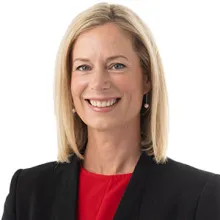
REBECCA WHITE, ASSISTANT MINISTER FOR HEALTH AND AGEING: Today is World Cervical Cancer Elimination Day, and in Australia we have a really proud record of supporting women to access screening, but also vaccinations to protect against developing cervical cancer. Australia is one of the few countries in the world that's on track to eliminate cervical cancer by 2035. But one of the things we need to remind people to do is to continue to get screened. And what is really exciting is that in Australia now, people can self-collect. We are seeing around 50 per cent of all cervical screens happening in Australia being done by women who are self-collecting. Around 550,000 Australian women chose this option for themselves last year, supported through their general practice to make sure that they can protect against the risk of cervical cancer.
Going and getting a cervical screen can be a pretty daunting prospect for a lot of people. And I know myself that I made sure that I booked an appointment with a female GP because I think a lot of us can feel a little nervous about getting a cervical screen. But what I discovered is that we can now do self-collect. It's really simple. Your GP just gives you the bit of information that you need, you go to the bathroom, you self-collect and then you come back, and it's done. Simple. It's painless and really quick.
I really do encourage Australian women to go and have a chat to their GP if they're due for a screen. You are able to self-collect with the support of your GP to make sure you can do that properly. And what it can do is prevent you getting cervical cancer because we can detect it really early, and that is a life-saving screening program that the Australian government has been really proud to invest in.
Alongside these, of course, we've been rolling out for a number of years now, vaccinations in our schools to make sure that all children, girls and boys, are vaccinated for HPV. And what we see across Australia is that 8 out of 10 children aged up to 15 years old are now vaccinated. But we want that to be much higher because this is a really simple vaccination program that's proven, effective, and a great public health measure that celebrates its twentieth year this year. We we’re encouraging people who have missed it because they might have been sick at school that day or something else might have come up, to book in with their GP because you can get a free catch-up vaccination up to the age of 25.
So, it's really simple again to make sure you are doing what you can to protect yourself against a disease that we know can be incredibly devastating, but we are on track to eliminate cervical cancer here in Australia because of our really strong public health programs around vaccinations and screening, and I do encourage all Australian women to make sure that they're up to date. It's a really simple thing to do. It's really painless, really quick, and you could be protecting yourself against a really insidious cancer.
EMMA SHOEMAKER, DOCTOR: We're really excited to be able to offer self-collected cervical screening. Gone are the days of the traditional Pap smear that's really daunting for a lot of women, and often was a reason that they would put off coming to see their GP for their cervical screening. So nowadays, most people, it's appropriate for us to offer them a self-collected cervical screening swab. We give them a kit and usually ask them to do it in the bathroom here, and they collect that sample themselves, and it's as easy as that. It's really effective at picking up HPV infection, which is something that over a number of years can lead to cell changes and eventually cervical cancer.
We also are able as GPs to offer catch-up vaccinations. We do encourage anyone who's missed their Gardasil vaccine at school to come and have a catch-up vaccine with a GP or with another professional in the community to make sure that they get their Gardasil vaccination, because the early vaccine against HPV is really crucial in helping us to prevent and hopefully in the future, be able to eliminate cervical cancer.
JOURNALIST: How much of an uptick has there been since the self-testing was introduced? And yeah, are people feeling more confident to just do it on their own?
DR SHOEMAKER: I think it's just gradually getting the message out there about the fact that self-collected cervical screening is an option. Often, people have come in thinking that they're going to get a formal Pap smear but are pleasantly surprised when we can just offer them a self-collected swab instead.
JOURNALIST: I guess how important is the combination of the screening and the vaccine in terms of I guess, yeah, getting onto it early?
DRSHOEMAKER: Yeah, so the screening is helpful for us to detect HPV infection that has already occurred, and then monitor the cervix for cell changes that may lead to cervical cancer over time. The Gardasil vaccine is a HPV vaccination that can help the body fight off the HPV infection and hopefully prevent the cervical cancer or cell changes from occurring. So we need both the vaccination program as well as the cervical screening program to help us reach this goal of eliminating cervical cancer in Australia.
JOURNALIST: Are enough people aware of the vaccine?
DRSHOEMAKER: I guess – I mean, the vaccination program does a really good job of making sure that all adolescents are flagged as being eligible for the vaccination for HPV.
JOURNALIST: How often are people supposed to be getting this vaccine? Is it a yearly thing or over a number of years?
SHOEMAKER: So, it's a one dose, and that's usually all it is unless someone has an immunocompromised immune system. So, for most adolescents, it's just one dose of the HPV vaccination, usually provided to them at school around the age of 12 to 13, and that is all we need to help protect them against HPV infections and hopefully the related cell changes from that.
RUBY FISHWICK, PATIENT: Well, I think the injection itself happening in Year 7, everyone's sort of aware that it's for cervical cancer, and that obviously it's a really relevant issue. Going to an all-girls school as well, I think we're all very aware of what it is and how dangerous it can be. Members of my family have had surgeries to remove cervical cancer. We've had stints with it. So, knowing that I was protected in such a way, and that it was so easy, it was one and done, 10 minutes in a classroom. Having that security and knowing that it was going to protect me in that way, not having to go through that myself, and then having people around me protected as well, knowing that it's going to make a change, I suppose.
JOURNALIST: And I guess getting that kind of injection, before then eventually getting your actual screening, does that kind of ease a bit of the pressure around it?
FISHWICK: Yeah, I mean, it would make it – I'm assuming, obviously, having not had a screening yet, but would make it a lot more – feeling a lot more secure in knowing that I've been protected and it's probably going to come out a lot cleaner than if I hadn't had the injection. Yeah, knowing that I'm protected in those sorts of situations, not having to worry about it as much.
JOURNALIST: I guess is it kind of reassuring to kind of start learning about it at such a young age, Year 7, to get – so that you're not overly scared about what could come?
FISHWICK: Yeah, absolutely. I think that the earlier that people know about these sorts of things, the more the awareness, the more that everyone knows about it, people know to go out and get vaccinations, people know that they can be protected. These things sort of spread a lot easier, they’re less of like a taboo topic as well.
JOURNALIST: And I guess, for the future, knowing that you could do your own screening is that kind of nice as well?
FISHWICK: Yeah, absolutely. Knowing I wouldn't have to have a Pap smear done, and having the security of doing it myself, it makes the whole thing a lot less vulnerable and a lot more keeping myself safe.