
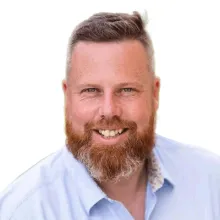
Thanks, Jorgen. It’s an absolute pleasure to be here. And thank you to Jonathan and everyone who has helped bring this conference together.
But most importantly, thank you to everyone in this room for what you do. The work MATES does saves lives. It changes lives. And it keeps families, workplaces and communities together. That is bloody important work, and I reckon you should give yourselves a massive round of applause for it.
There are also a couple of people in the room who know me pretty well. Penny knew me from a very young age. In fact, I was the first baby she ever held. I’m 44, so I’ll let you all do the maths on that one. I’m not giving away anyone’s age!
And John is here too. I’m mates with his niece and her husband, so it’s great to have a couple of familiar faces in the room.
For those who don’t know much about me, I’m the Federal Member for Hunter. But I actually grew up in Melton South. Who’s from Victoria? Put your hands up. There we go.
I left school at 15 and became a fitter and turner. I worked at Ford and Toyota maintaining production lines before moving up to the Hunter. I worked in mining, ran engineering workshops and spent pretty much my whole working life around blue-collar industries.
I’m also a five-time Olympian in pistol shooting and won three gold and three bronze medals at the Commonwealth Games. So I often call myself the accidental politician. Because I can tell you, when I left school at 15, becoming a Federal MP was absolutely nowhere on my bingo card.
In 2021, the former Member for Hunter, Joel Fitzgibbon, asked whether I’d consider having a crack. It took a bit to get my head around. People from backgrounds like mine don’t always grow up believing places like Parliament are for people like us.
But I decided that whether I was there for three years or 30 years, I was going to be myself, represent my community the best way I could and have a bloody good time doing it. I’m not your typical politician. And anyone who has heard me speak before probably already knows that.
I’ve also got a great team around me, including a couple of them here today. They keep the shit show on the road, and I couldn’t do what I do without them.
During my first term, I spoke a hell of a lot about men’s health. I’ve also been pretty open about my own health. I’m six-foot-eight and, at my biggest, I was 152 kilos. I’ve lost around 35 kilos.
And despite being an Olympian who had access to some of the best coaches, doctors, psychologists, physios and dietitians in the world, I still managed to ignore most of their advice and get massive. That probably tells you something about blokes. We can be bloody good at knowing what we should do while doing absolutely none of it.
When I decided I needed to do something about my weight, I did what plenty of blokes do. I looked for a shortcut. I went to one of the doctors in the Labor caucus hoping they would just write me a script. They told me to go and see my GP.
So naturally, I went to the other doctor in the Labor caucus. He told me exactly the same thing. I reckon they had rehearsed it. But they were right. Going and having that proper conversation with a doctor was one of the best things I could have done.
And that brings me to why the Prime Minister appointed me as Australia’s first Special Envoy for Men’s Health. It doesn’t matter whether you vote red, blue, green, orange or anything else. For the first time, an Australian Government has someone specifically tasked with going out and talking about the health of men and boys.
I’m incredibly proud of that. Because there is a problem here that we have ignored for too long. Australian men live around four years less than Australian women on average. And health outcomes generally get worse as you move further away from our major cities.
Then there’s mental health. More than three-quarters of Australians who die by suicide are men. Behind every one of those numbers is a bloke. A family. A mate. A workplace. A footy club. A community.
That is why organisations like MATES matter so much. You’ve worked out something that governments and health systems sometimes struggle with. You meet blokes where they are. You speak their language. You build trust. You get people looking out for each other. And you make asking, “Mate, are you actually alright?” part of the workplace.
But I want us to take that same approach beyond mental health. We need blokes looking out for each other’s physical health too.
Take prostate cancer. Around 4,000 Australian men die from prostate cancer every year. And too many blokes still avoid the conversation because they think getting their prostate checked automatically means a finger up the backside. I can see a few people smiling.
For many men, the first step is simply talking to your GP about your risk and whether a PSA blood test is appropriate for you. Depending on your age, family history, risk and results, your doctor can then talk you through what happens next.
So if you have a family history of prostate cancer, particularly a father or brother who has had it, have the conversation with your GP. Don't sit there thinking, “She’ll be right.” Go and ask. It could save your life.
And to the women in the room, you have an enormous role in this as well. You have husbands, partners, fathers, sons, brothers, uncles and mates. Sometimes you are the reason the bloke in your life finally makes the appointment he has been putting off for six months.
I used to call that nagging. Apparently I'm not allowed to call it that anymore. So we'll call it positive reinforcement. Keep positively reinforcing the shit out of them.
Then there’s bowel cancer. Who here is 45 or older? You’re now eligible for the National Bowel Cancer Screening Program. If you’re between 45 and 49, you can request a free kit. From 50 to 74, the government sends you one every two years.
And fewer than half of eligible Australians are actually doing the test. Men are even worse at it than women.
This is literally one of the only times you can put some of your own shit in the mail and send it back to the Australian Government. And trust me, as a politician, plenty of people send me shit. But this shit can actually save your life. So do the bloody test.
And if something changes with your bowel habits and stays changed, don't ignore it. If there’s blood, ongoing pain, unexplained weight loss or something just isn't right, go and speak to your GP. Don't diagnose yourself on Google. Don't ask your mate Mick at smoko. Go and talk to someone who actually knows what they're talking about.
And that's really the bigger message I want to leave with you today. We need to change the way blokes think about healthcare.
Too many men treat the doctor like a mechanic. We don't go in for servicing. We wait until something is completely rooted and then expect someone to fix it.
Women generally have contact with health professionals from a younger age. A lot of blokes grow up going to the doctor only when Mum finally decides the arm we've been complaining about for three days might actually be broken. So we learn that doctors are somewhere you go when you're sick or injured.
We need to change that. Seeing your GP isn't admitting there's something wrong with you. It is maintenance. It's preventative. It's about understanding your blood pressure, cholesterol, diabetes risk, cancer risk and whatever else might be appropriate for your age and circumstances.
Let me ask the blokes in the room. Put your hand up if you've been to your GP in the last 12 months for a proper health check or conversation about your health.
That's actually pretty good. Clearly MATES is doing something right. Because when I go into mine sites, workshops, construction sites and other blue-collar workplaces and ask the same question, sometimes the number of hands is bloody frightening.
Then I ask how many only went because they needed a medical certificate. A few more hands normally go up.
We have to change that culture. And you are perfectly placed to help us do it.
MATES has shown what happens when people inside an industry decide that looking after your mate isn't somebody else's responsibility. You have changed the conversation around mental health and suicide prevention in industries where, for a long time, people simply didn't talk about this stuff.
Now I want to see us build on that. Talk about mental health. Talk about suicide. But also talk about heart health. Talk about prostate cancer. Talk about bowel cancer. Talk about getting a check-up. Talk about that bloke at work who hasn't looked right for a couple of weeks.
And if your mate tells you something isn't right, don't just say, “She'll be right, mate.” Help him do something about it.
Because the strongest thing a bloke can do isn't pretending nothing ever affects him. It's looking after himself so he can keep turning up for his family, his mates and his community. That's what all of you help people do every single day.
MATES has strong support across politics because what you do works. You save lives. You change workplaces. And you keep people with us who might otherwise not be here.
So thank you to Jorgen. Thank you to the entire MATES team. And thank you to every single person in this room who takes this work back into their workplace and their community.
Keep having the conversations. Keep checking on your mates. And while you're at it, make sure you're looking after yourself too.
Thanks very much. I'm happy to take a few questions.