
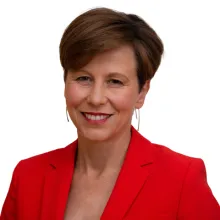
TOM CONNELL: Jenny McAllister, sort of a bit abrupt there. So apologies if I caught you by surprise. So I found this interesting. The aim is to get 600,000 participants by 2030, the previous estimate was 550,000 way back when it was designed, which is a while ago. What's the reason for that that difference? Why not just 550,000?
JENNY MCALLISTER: Well, I think the aim is, in fact, to return the scheme to its original purpose and have a scheme that you know is financially sustainable, delivers services for the cohort of people for whom it was originally intended, and operates in a way that is safe and delivers quality services. So the goals are probably a little broader, and we see this as a …
TOM CONNELL: So a few more people because the goal is slightly different to the day it was implemented. Is that?
JENNY MCALLISTER: I think it's unsurprising that the Productivity Commission's analysis from way back when has changed or varied a little in the years since, but we see this as a key human rights achievement for people with disability. We see it as a key social policy achievement for Australia. We think it's something that Australians remain very proud of, but we do think it's off track and it needs to be re-established.
TOM CONNELL: One of the things Mark Butler spent time on today was the social inclusion budget, which is blown out a lot. What's an example of either an activity that shouldn't fit within this or something that's being way overcharged? Because we always hear about broad terms, and what are some examples here?
JENNY MCALLISTER: I don't think it's particularly the case that we think any particular activity is right or wrong. We want participants to have choice and control about how they spend their time, and this budget is designed to support community inclusion. But we do observe that it is a part of the NDIS budget that has grown very rapidly. It presently costs about as much as we pay annually on the PBS, and we simply think that that kind of cost growth can't be sustained in the future.
TOM CONNELL: Leave the choice. But are there examples of how much, you know, it's first included, and people are being charged whatever it might be to go and get a haircut or attend a concert or something, and that's skyrocketing. Were there examples that came across your desk and you just thought, this can't be, people should not be charged this much?
JENNY MCALLISTER: As I say, it is really about the quantum. This has grown very rapidly, and we simply don't think that that is a sustainable way.
TOM CONNELL: So people are getting approved to use the budget. And you're saying it's not, it's not that people suddenly, the cost to get to some of the shops is double. That's not the issue for this. It's just that people are getting approved to use more and more and do more and more things, and you need to make it sustainable.
JENNY MCALLISTER: That is roughly a fair assessment about the dynamic. I think the other thing we would observe is that if you go back to the original principle, which is that we want people with disability to be genuinely included in our society. We are not confident that this particular expenditure is delivering particularly great value for people with disability. In some instances it is immensely important, but there used to be a series of programs and activities where people could become genuinely connected to other people. I mean, a community involves interacting with people, in a sports environment or in the arts.
TOM CONNELL: It's not just subsistence keeping someone alive, that's what this is. But when you say value for money, doesn't that imply that the charges were getting unreasonable?
JENNY MCALLISTER: It's not so much about the price. It's about whether the outcome that is being delivered for the person with disability is sufficient to justify the quantum of expenditure. Because we are talking about a program that presently costs $12 billion a year and is on track to rise to $20 billion. We don't think that that is something that we can sustain. We understand it will have impacts, and we're interested in the investments we can make to build up some of those community programs that most Australians take for granted. Most Australians want to be able to be part of a sports club or become involved in some other kind of group. A lot of that is moving away, we think that we can make some direct investments to help community organisations be more inclusive of people with a disability.
TOM CONNELL: Do it at scale activities and get better value. Plan management. So a big focus on this. And again, I'm conscious that a lot of our viewers wouldn't know all the ins and outs of this, but is the issue here that people in charge of these plans were misusing the money, directing it certain ways to benefit them? Why has this become such a place where money is disappearing in the NDIS?
JENNY MCALLISTER: Plan managers play a really important integrity function in the scheme. They exist to support people with disability in the NDIS to use their plans appropriately, consistent with the allocation to them and to purchase services that are actually delivered by providers. Lots of plan managers do a great job of that, but unfortunately, we do have a lot of evidence about plan managers not doing the right thing.
TOM CONNELL: Overcharging for their service, is that the most obvious one?
JENNY MCALLISTER: The most significant concern, from my perspective, is allowing, services, either diverting participants to service providers where there's a conflict or allowing inappropriate claiming, which has real costs for participants. Our proposal is to reform that area. Those intermediaries cost government quite a significant amount of money each year. We think we can get better value, see those integrity functions performed better and actually, again, deliver better outcomes for people with disability.
TOM CONNELL: Those on Thriving Kids. It hasn't started yet, but we think of the lower level behavioural Autism Spectrum needs, when they're going to access an OT or a psych session, will they necessarily still be free of charge? Or that be more about subsidised care? Or is that still unclear?
JENNY MCALLISTER: The states and territories, as you know, have taken responsibility for rolling out the bulk of those targeted interventions as part of Thriving Kids. So Thriving Kids will have services to support parents. It'll have good information for parents who have questions about whether or not their child is on track to meet all the milestones that you might expect. But it will also involve some what are called targeted supports. The states and territories are in the process of defining how they intend to deliver those, that’s part of the implementation work that they’re doing.
TOM CONNELL: People could go from fully paid for care now to subsidise, if they're in the category of low and middle needs. Is that fair to say right now?
JENNY MCALLISTER: The Thriving Kids program will have, as I say, support for families because parents are the best teachers. It'll have good information for parents who are worried about their child's development. But will also provide the opportunity for some children to be able to receive supports of the kind that you describe.
TOM CONNELL: Right and it's unclear now whether that might be depending on different elements subsidised or fully paid for?
JENNY MCALLISTER: We've got models that look like this in the community before, like Community Care is a long-standing feature of child development services. We're keen to build that up, and the states and territories are in the process of building out their implementation plans for those services.
TOM CONNELL: Okay. Just finally, states, there's been some wrangling over this. David Crisafulli has had a crack again today, extra funding for hospitals, will that be withheld? I mean, how serious is the Federal Government about making sure they play their part? The states play their part?
JENNY MCALLISTER: I think our starting point is that the Australian people expect the Commonwealth and the states and territories to work together, both on hospitals and on disability. They want good hospital services. They want good health care. They want credible disability services. We've worked really hard to negotiate a set of arrangements with the states, and I am really pleased with the work that is being done in many jurisdictions to get Thriving Kids on the move.
TOM CONNELL: You think things are going better than the headlines.
JENNY MCALLISTER: I think that there are many states and territories who were doing a really good job getting on with this, and I think the people of Queensland will want to see their government doing the same thing.
TOM CONNELL: Will you do this threat if you have to? Pull the money?
JENNY MCALLISTER: I think we'd prefer to see us work through these issues in a collaborative way.
TOM CONNELL: Minister Jenny McAllister, appreciate your time today.