
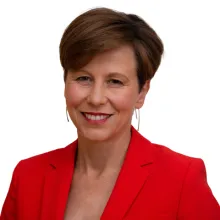
MELINDA JAMES: I'm very pleased to welcome the federal NDIS minister, Jenny McAllister, who's been good enough to give us some time this morning. Jenny McAllister, good morning.
JENNY MCALLISTER: Thank you. Good morning. Melinda.
MELINDA JAMES: Can I just ask one question, just quickly to set the scene? There's a lot of talk about the original purpose of the NDIS, and I'm just wondering, in relation to the original purpose. What is that? Is it about helping people survive? Or is it about more than that, helping people thrive? Is it about participation? Just the original purpose? Just briefly that we keep saying we need to return to what is that?
JENNY MCALLISTER: That is a great question Melinda, because it goes to a number of the things that we've been thinking about really carefully over the last year. The original purpose of the NDIS was to provide choice, control, dignity and independence to those people with the most significant and permanent disabilities. And we always understood that that would not be every person with disability in Australia, there's somewhere around 5 million Australians living with disability at the moment, around 760,000 of those people are on the scheme. Our assessment is that that is nonetheless more than the cohort for whom it was originally intended. And the challenge we've faced is that since the NDIS was established, many of the other services around the country that would have supported people outside the scheme have been allowed to wither away. And of course, people with disability have flocked to the only option available to them. We don't think that's a sustainable way to proceed. We want this scheme to be here for the long term, and that's the reason that we're making the reforms that we announced on Wednesday.
MELINDA JAMES: Okay, well, then a couple of questions about what it will mean to be eligible for the NDIS into the future. Will every person who is currently an NDIS participant be reassessed?
JENNY MCALLISTER: We do expect so, and we don't expect to commence that until 2028. It's possibly worth explaining some of this for your listeners. The NDIS was designed for people with permanent and significant disability, but when it was first rolled out, essentially a set of lists were created where, if you had a diagnosis of a certain kind, you were automatically admitted over time. We don't think that that's been working well. And we'd like to return to the original vision, which was that you'd be assessed based on your functional capacity. What are your actual needs? And for people who have significant needs, we need to understand what they are, and those people should continue to be supported by the scheme. We know that this represents a change in the way access to the scheme currently works, and our intention is to work closely with people with disability to establish these arrangements in the coming year.
MELINDA JAMES: Jenny McAllister, we're having a little issue with your phone. You're just fading in and out. I'm not sure if there's anything magical you can do to sort that out. We'll persevere for a little bit, but it is fading in and out. I just thought I should let you know,
JENNY MCALLISTER: Is this better?
MELINDA JAMES: Yeah, that's better. Thank you. Terrific. Yeah, that's great. Okay, so we're hearing about this functional capacity assessment tool that will be developed over the next 18 months or so, in consultation with the community of people who live with a disability and their support workers, etc. So all the stakeholders will be a part of that. But what do you anticipate that will look like? There's been a bit of talk about the World Health Organization having an assessment tool that measures, I guess, functional capacity in a sense, is that something you're looking towards and how rigorous a process will this be?
JENNY MCALLISTER: I don't want to get ahead of the work that we'll do with people with disability and with the extensive expertise that exists in the Australian community of clinicians, but functional capacity assessments are already a feature of the scheme, whilst some people access the scheme via diagnostic lists, others already use functional capacity assessments to provide evidence of their needs. We'll work with the people who know those systems best, of course, we'll look at international tools, and our intention is to establish a technical advisory group that can provide advice to government, but also seek advice from the disability community about what will work best for this scheme.
MELINDA JAMES: We keep hearing about the up to 160,000 Australians who will be removed from the program by the end of the decade, but it looks like the first cohort of people to be identified and removed from the NDIS will most likely be children under the age of nine with autism diagnoses. We've already heard about thriving kids, which will be the state based programs and funded programs. It's due to begin on the first of October, but we still don't know anything about what thriving kids will look like, whether it will be consistent across states and across the country, whether people will be entitled to the same level of services. Chris Minns has said already that people can't expect like for like when they're swapping from a federal system to a state system. What can people who are the parents or loved ones of children with autism diagnoses expect come the first of October?
JENNY MCALLISTER: For children with low to moderate support needs, we really don't think that the highly individualized services of the NDIS works for them well. It takes too long to gain access, and in that period, there are so many missed opportunities to support parents to support their own children and to intervene directly with those children. We've developed a national framework for thriving kids based on really terrific expert advice and consultation. Its core pillars are really good information that's easily accessible for parents who are worried about their kids, diversion pathways or referral pathways from within those natural settings where children are frequently presenting like maternal child health centres or early education and learning, and targeted supports delivered by states and territories to children.
We said that these supports would start to roll out this year, and the states and territories are busily developing their implementation plans, but we don't expect that rollout to be complete for some time. Minister Butler has made it clear that we don't see children exiting the NDIS until that rollout is in place.
MELINDA JAMES: Okay, and there's no guarantee of the same level of support that children currently receive under the NDIS once they're switched over to thriving kids. Is there?
JENNY MCALLISTER: For children with low to moderate support needs, we really don't think that the We think this system will work better for families and for children. It's built on the best practice principles about early childhood intervention, and it involves a whole of child and whole of family approach to providing support. Parents are often the most important teachers in a child's early years. Much of the focus of the program will be about supporting parents so that in each and every interaction they're having daily with their very young children, they are working with them to reinforce whatever additional supports those children may be receiving.
MELINDA JAMES: And choice is another thing that people might find is affected. At the moment, under the NDIS, they have quite a degree of choice in the services that they choose to have for their child. That might not necessarily be the case under thriving kids will it?
JENNY MCALLISTER: There's a flip side to that argument Melinda, which is that many parents report finding that choice overwhelming. You are given a budget, you know that your child is missing some milestones, has some developmental delays, and as a parent, you're asked to determine what services will be best for your child. We actually have a great evidence base about what works for children in these cohorts and the thriving Kids program will actually be a curated set of services tailored for children who are experiencing developmental delay or challenges with an autism diagnosis will be able to assist those children and those families in The ways that the experts tell us will actually work, and I think that'll be a great relief for many parents who, to date, have been left to navigate these systems largely unsupported. They have money, but not necessarily the information that they need to source the kinds of supports that their children might be needing.
MELINDA JAMES: I'm speaking to the Minister for the NDIS, Jenny McAllister, another concern among people and for people who don't have much connection to the NDIS. Often, there's a lot of scoffing about some services that people are provided with by the NDIS, being taken on holidays or to the movies or whatever. There's a lot of discussion about that often, so these social and community supports that will be looked at and most likely removed from the NDIS is there, is there any kind of middle path here? Because a lot of Disability Services and advocates have talked about how life changing and transformative it can be for someone to be taken to a concert that they couldn't otherwise get to, for example, a hypothetical example. So will all social and community supports be gone? And what's what's the definition of that?
JENNY MCALLISTER: The short answer is no, we recognize the significance of social and community supports. And what's been announced is not in any way a removal of that kind of support for people disability, but it is a restoration of those supports back to a more reasonable level.
This is one of the fastest growing parts of the scheme. It currently costs the scam around $12 billion a year, and to put that in context, that's actually about the same amount we spend nationally for all Australians on the PBS. Our intention is to return that to the levels that existed a couple of years ago. People will still be able to access this kind of support, just not in quite the same volume as at present.
We know too that some of the kinds of supports that used to exist for people with disability, again, have faded away with the NDIS, and we're establishing a $200 million inclusive community scheme that will be able to provide support to local community organizations to generate genuinely inclusive community experiences for people the way things used to work.
MELINDA JAMES: I think we're going to have to move on, sadly, but I know that there will be plenty of discussion between now and, most particularly, the first of January 2028 when we're expecting all this to come into force. But I very much appreciate your time this morning. Thank you.
JENNY MCALLISTER: Thanks, Melinda.