
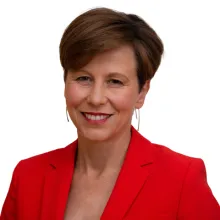
LORETTA RYAN: Jenny McAllister is the Minister for the National Disability Insurance Scheme, and joins us. Good morning, Minister.
JENNY MCALLISTER: Good morning, Loretta. Good morning, Craig.
LORETTA RYAN: Talk us through these changes, if you would. What are they? When will they happen?
JENNY MCALLISTER: This is a really important reform. The NDIS is a great human rights achievement for Australia and for Australia's disability community, but it is off track. It costs too much compared to other equivalent government programs. It's distorting other parts of the care economy and not providing sufficiently high-quality care, and there is too much fraud. And so yesterday, we announced very significant changes, and we acknowledge they are significant, to get this program back on track so that Australians can retain their justified pride in this world leading Scheme.
CRAIG ZONCA: So for participants of the Scheme and their families who are listening this morning, what changes for them, Minister? And when will that change happen?
JENNY MCALLISTER: The first area is around the quality of services that are being provided. We intend to require people providing high risk services to register, and when complete, that will mean that 90% of the payments going through this Scheme will be going to registered providers, and we think that's an incredibly important uplift in the quality and the safety of services that will be provided to disabled people. We'll also improve the Plan Management system, those middle managers, some of whom are doing a great job, some of whom are merely clipping the ticket so that we have high integrity, high quality plan management services. And we'll build a payment system so that the NDIA has visibility over all payments and where they are going. These are incredibly important interventions, because the NDIS has become a soft target under the arrangements that put in place under the Liberals.
CRAIG ZONCA: Am I looking and reading this correctly, that everyone on the NDIS is going to be reassessed?
JENNY MCALLISTER: That is correct.
CRAIG ZONCA: That's huge. That's a massive undertaking. I hear reports from some organisations that when they request a reassessment, they can take nine months before it happens right now.
JENNY MCALLISTER: One of the things that has occurred is that the NDIS, which was originally designed for people with permanent and significant disability, has really significantly expanded. We want this scheme to be here for the long term, and we want it to be available in a decade's time for a little boy or girl who is born with very significant support needs. That means putting some boundaries around who this scheme is designed for and what kinds of services they receive. We received a recommendation back in 2023 that said we needed a clear definition of this and a clear way of establishing whether or not a person is eligible, and that's work we intend to do. We announced that yesterday, we'll work with the technical advisory group on how this is rolled out. We'll consult deeply with the disability community on how this is rolled out. But we do think it's important to secure the long-term sustainability of the scheme and maintain community trust in the Scheme.
LORETTA RYAN: Have you heard that there have been people who are stressed thinking they're going to be taken off and they don't know where to turn. I mean, this is a problem for people who aren't quite understanding now these eligibility rules and the assessment process.
JENNY MCALLISTER: I know that any change is always challenging for any community, and particularly for the disability community, and I hope to be able to speak in deep ways on a very regular basis with the disability community in the coming weeks and months. But whilst this change may seem challenging, what would be genuinely frightening would be a collapse of community trust in this scheme overall. And some of the statistics we see are that while Australians are very, very proud of this scheme, which operates for potentially, all Australians, any one of us could be afflicted by disability at any point in our lives, people are worried about it. They do think that it costs too much, and they're concerned about the rate of fraud within the scheme, and we do need to put some clear boundaries around this incredibly important social achievement.
CRAIG ZONCA: Okay, let's talk through a bit more detail here. The NDIS Minister Jenny McAllister is with you this morning here on 612 ABC, Brisbane. We're trying to make sense of the reforms proposed, announced yesterday, and what it will mean for you. Autism has been a big part, a big talking point. Nearly four in five of all entrants to the NDIS, and nearly half of all current participants are people living with autism. I want to play you some audio from Steve Austin's program here on 612 ABC Brisbane yesterday, from Dr James Morton, the founder of the AEIOU Foundation, which in recent months, has been forced to shut down. Minister, take a listen to this.
“STEVE AUSTIN, HOST: Did the NDIS and its structure kill your foundation?
JAMES MORTON, AEIOU: It did, Stephen, and it was a process that they ran over many years. And ultimately, what they did at the end of 2024 was suddenly cut funding packages from six hours of therapy down to two hours of therapy, and actively told families that they shouldn't go to AEIOU. It didn't matter what the families earned. It didn't matter their social status. It didn't matter if they were single parents, dual parents, the program worked, and we demonstrated it worked, and we published those outcomes, and we published the cost benefit analysis. We go back to the Productivity Commission's guidelines for early intervention that had to be safe, evidence based, cost effective. We are the sole provider in Australia that demonstrated that. The model they're proposing has no evidence base. We did all those things, and we were shut down.
STEVE AUSTIN, HOST: And I want to make it clear, you've not been able to get a meeting with the Federal Minister for the NDIS, Federal Labor Minister, Jenny McAllister, not been able to get a meeting.
JAMES MORTON, AEIOU: Or Minister Butler.”
CRAIG ZONCA: James Morton there, the founder of the AEIOU Foundation, Minister, why haven't you been able to sit down with James Morton and understand their frustrations at the AEIOU Foundation and the reasons why, well, it is now shut down.
JENNY MCALLISTER: Our agency has worked very closely with AEIOU over their business challenges over the last few years. One of the things that your listeners should understand is that the NDIS doesn't fund particular businesses. We fund individuals, and we provide individual supports to people with disability in line with their assessed needs and their development goals. We don't fund entire programs of support, and we also don't fund any early learning environments. When we set up the NDIS, it was never intended to replace childcare, or to replace hospital systems, or to replace school systems. All of those big service systems should be inclusive for children with disability. Our approach has been to fund, to provide funds, reasonable and necessary supports to children with disability, and they can their families can choose where they spend those resources.
LORETTA RYAN: But Minister, Dr James Morton, as you heard there, basically said the very scheme set up to help people help destroy that organisation, the AEIOU.
JENNY MCALLISTER: I understand Mr Morton's perspective. Mine is slightly different. We have provided very significant resources to many children, and they've benefited from those resources. We are, as your listeners probably know, moving to a system called Thriving Kids, where we'll see significant new resources stored up in the community so that children can access a range of services where they've got low to moderate support needs and they're experiencing developmental delay or autism. We think rebuilding those community supports is really important. It's one of the reasons it's been such a priority for Minister Butler and I over the last year.
CRAIG ZONCA: Well, you mentioned Thriving Kids. Queensland hasn't even signed up to it yet. This was the Queensland Health Minister Tim Nicholls in studio with us yesterday.
“TIM NICHOLLS, QLD HEALTH MINISTER: All the states are supposedly agreeing to Thriving Kids, but no one knows what it is. There's no single platform. I speak to my colleagues in New South Wales, and they say we don't know what the Commonwealth wants us to do. We haven't been told. We've been told to design a system from the ground up. We don't have a system in place in Queensland, and so we are simply saying to the Commonwealth, until you can tell us what this looks like and can confirm the funding arrangements in place for it. This is not a deal that is going to benefit young children who need that support.”
CRAIG ZONCA: So Queensland is going to miss out at the moment, Minister, by the sound of things, are we simply going to fall through the cracks? Why isn't there a clear indication as to what Thriving Kids will mean for Queensland families right now?
JENNY MCALLISTER: The Queensland Government, and all state governments, signed up to a new arrangement to deliver a couple of things, very significant increases to hospital funding and a new system of supports called Thriving Kids. There are clear national principles about what Thriving Kids will involve. There is clear funding on the table, including Commonwealth funding to roll out Thriving Kids.
CRAIG ZONCA: Doesn’t sound like it. The Minister says there's not that clear guidance as to what it's going to mean.
JENNY MCALLISTER: Well, there's always a little bit of political posturing around these kinds of questions, isn't there, Craig? But my view is that Queensland families do want the Queensland Government to get on with this. They don't really want to see the Queensland Government and the Commonwealth arguing about it. This has been going on for some years now. Queensland families will welcome additional Commonwealth investment in their hospitals, and they will welcome additional Commonwealth investment combined with state investments in new programs for children who've got support needs. And we'd like to see the Queensland Government get on with that.
LORETTA RYAN: Just also a question from the Endeavor Foundation, how will you ensure you will have enough quality providers left to support people with complex support needs?
JENNY MCALLISTER: That's a really important question, Loretta. And some of these reforms are absolutely targeted at supporting the quality providers in the market. When we're talking about requiring registration for high-risk activities, what we're really saying is that we will no longer accept substandard providers in the market. Good providers who pay their staff well, who have good clinical governance, who treat their obligations to their participants with utmost seriousness, should not be in competition with low budget providers whose main interest is making a quick buck. Registering providers, tackling fraud, setting up a proper payment system, are all active steps we're taking to steward this market so that very good providers, of whom there are many, are well supported in the system, rather than undermined by poor quality entrants.
CRAIG ZONCA: There's lots to happen in this space. As you say, this is the start of many more discussions about the future of the NDIS and these sweeping reforms announced yesterday. Jenny McAllister, thanks so much for your time this morning.
JENNY MCALLISTER: Thank you, Craig and Loretta for having me. I really appreciate it.
CRAIG ZONCA: The Federal NDIS Minister Jenny McAllister.